
How AI Agents Are Transforming B2B Go-to-Market
The GTM problem is coordination, not effort B2B go-to-market teams rarely struggle because they have nothing to do. They struggle because the work is spread across too many disconnected steps. Research the ideal customer profile. Find decision-makers. Write content. Launch email outreach. Send LinkedIn messages. Manage replies. Update the CRM. Review performance. Plan the next campaign. Each task may have its own tool, owner and process. The handoffs between them are where context gets lost,
By Growstack
The GTM problem is coordination, not effort
B2B go-to-market teams rarely struggle because they have nothing to do. They struggle because the work is spread across too many disconnected steps.
Research the ideal customer profile. Find decision-makers. Write content. Launch email outreach. Send LinkedIn messages. Manage replies. Update the CRM. Review performance. Plan the next campaign.
Each task may have its own tool, owner and process. The handoffs between them are where context gets lost, follow-ups slow down and campaigns become difficult to improve.
AI agents are changing that model.
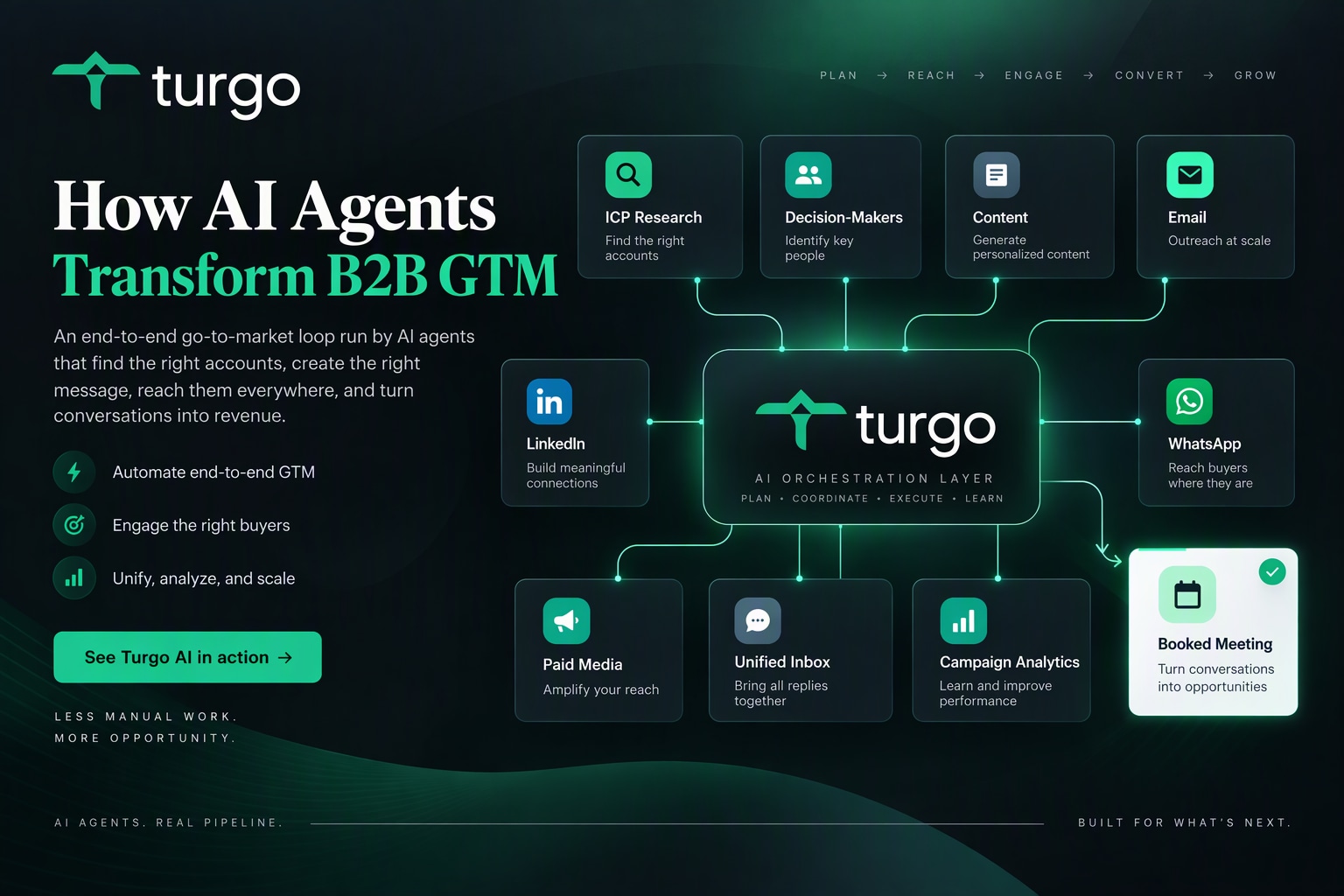
Rather than treating content, outreach, replies and reporting as isolated activities, AI agents can help connect them into one revenue operation: a loop that learns from the business, executes across channels, records activity and uses results to inform what happens next.
What AI agents change in B2B go-to-market
The value of AI agents is not simply faster copywriting or a larger prospect list. Their real value is coordination.
A connected AI-led GTM motion can support the work across the full journey:
- Understand the business: learn from the company website and approved brand context.
- Build the foundation: shape the ICP, messaging and campaign direction.
- Find decision-makers: identify the people and accounts that fit the target audience.
- Run coordinated campaigns: support content, email, LinkedIn, WhatsApp and paid media from one system.
- Manage replies in context: bring responses into one inbox and draft relevant answers.
- Keep the record current: track campaign activity against the contact.
- Review and improve: assess what worked and propose the next campaign.
This turns the GTM process from a chain of manual handoffs into a connected operating loop.
From point tools to an operating loop
Point tools can be useful. One may help find contacts, another may send email, another may schedule social posts, and another may report on results.
But a collection of tools is not automatically a system.
When the steps are disconnected, teams still have to coordinate the work manually:
- Export contacts from one tool.
- Move them into another campaign.
- Rewrite context for a different channel.
- Track replies in separate inboxes.
- Reconcile activity across systems.
- Interpret the results before deciding what to do next.
AI agents make a larger difference when they connect these steps.
For example, an approved ICP can inform who gets researched. That research can shape outreach. Campaign activity can sit alongside replies. Replies can inform follow-up. Performance can guide the next campaign.
The result is not just more activity. It is more continuity across the revenue operation.
Why this matters for B2B teams
For B2B companies, go-to-market execution is often multi-channel by necessity. Buyers may see a LinkedIn post, receive an email later, visit the website, reply in another channel and eventually agree to a meeting.
The challenge is preserving context throughout that journey.
A connected AI-driven approach helps B2B teams:
- Reduce manual coordination across channels.
- Keep messaging closer to the approved brand and ICP.
- Bring conversations into one place for faster follow-up.
- Make campaign review part of the operating rhythm.
- Improve the next campaign using the results of the last one.
That matters because pipeline generation is not a single action. It is a sequence of informed actions, followed by learning.
The role of human approval
AI agents do not remove the need for judgement. They make the execution layer easier to coordinate.
B2B teams still decide what their business stands for, who they want to reach and which messages should represent the brand. The best operating model keeps people responsible for those decisions while using AI to run the repeatable work around them.
That is especially important for outbound communication and paid media. Teams should be able to review campaigns before they go live and maintain control over what gets sent or published.
AI agents make revenue operations more connected
The next phase of B2B GTM is not about adding another isolated AI tool to the stack.
It is about connecting the full loop: targeting, messaging, execution, replies, reporting and improvement.
Turgo AI helps B2B teams run content, email, LinkedIn, WhatsApp and paid media from one system. It brings replies into one inbox, drafts answers in context and reviews campaigns on schedule so teams can improve what happens next.
For B2B teams, that is the promise of AI agents in go-to-market: not just faster tasks, but a more connected revenue operation.


