
How do firmographic technographic and intent data cut CAC?
Firmographic, technographic and intent data combines company, tech and behavioral signals — and for GTM teams, it directly impacts CAC and pipeline velocity
By Srikanth inuganti
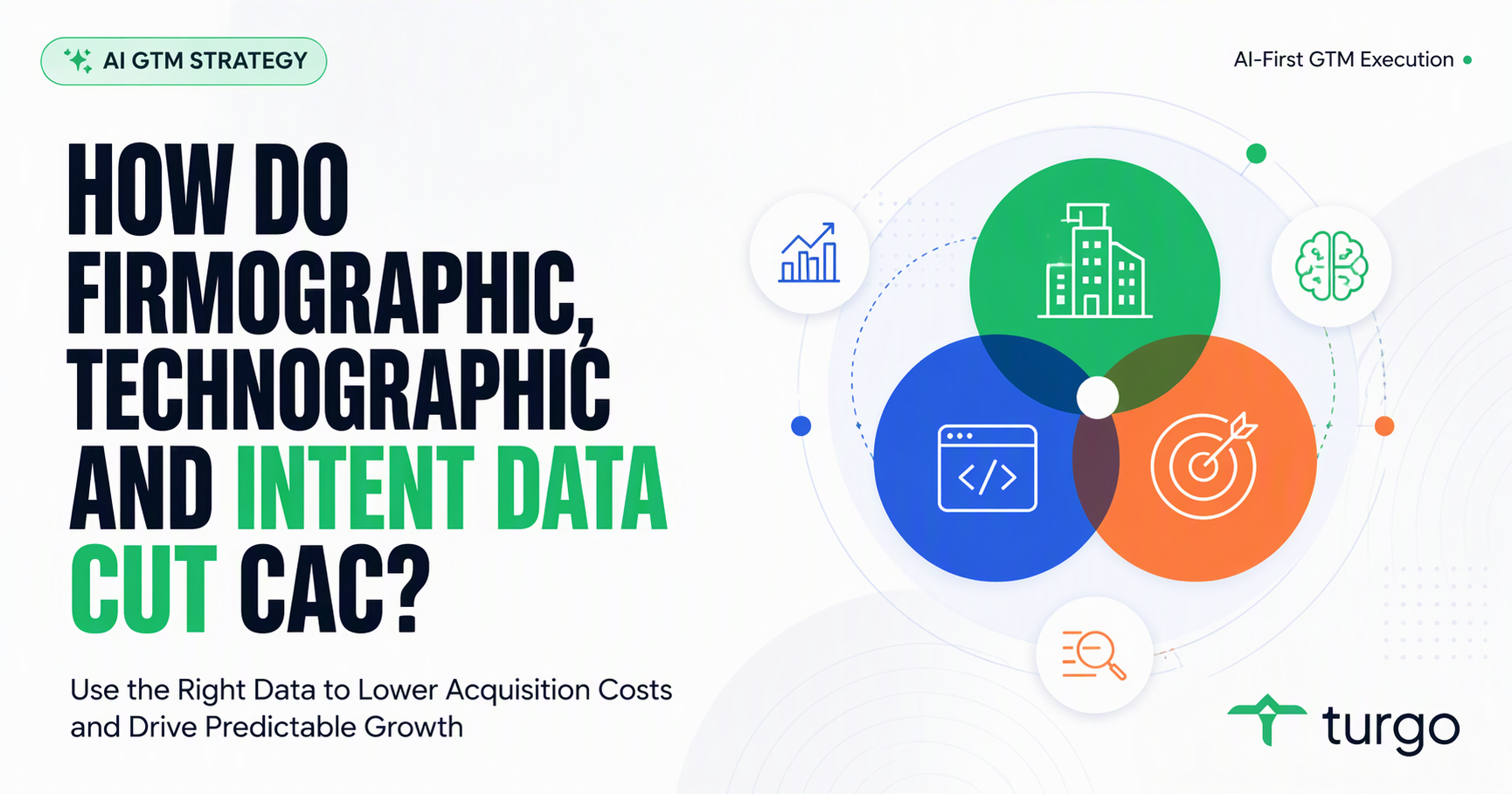
Firmographic vs Technographic vs Intent Data Explained
Compare firmographic, technographic, and intent data to improve account targeting, prioritize outreach, strengthen pipeline efficiency, and support scalable GTM execution.
Choosing the right company data is rarely a question of finding the biggest database or the longest list of attributes. The real question is whether your data helps the team decide who to target, why the account may fit, and when outreach is most relevant.
Firmographic, technographic, and intent data answer different questions. Firmographics describe the company. Technographics reveal the systems it uses. Intent data indicates whether people at that company may be researching a relevant problem. Used together, they can create a more useful account-prioritization model than any single data type alone. Used carelessly, they can create noisy segments, irrelevant outreach, and wasted sales capacity.
For marketers, founders, and revenue leaders, the practical goal is not collecting more company data. It is connecting the right signal to the right action across marketing automation, AI outbound, and broader GTM operations.
What Is Firmographic vs Technographic vs Intent Data?
Firmographic, technographic, and intent data are three complementary forms of B2B company intelligence. Firmographic data describes an organization's characteristics, technographic data shows its technology environment, and intent data reflects research or engagement signals associated with potential buying activity. Together, they help teams assess fit, relevance, and timing.
- Firmographic data: industry, location, company size, revenue range, and organizational structure
- Technographic data: software, infrastructure, platforms, integrations, and tools in use
- Intent data: content engagement, searches, website activity, and other research signals
- Account scoring: combining signals to rank companies for attention
- Activation: using the data to personalize campaigns, routing, qualification, and outreach
What Is Firmographic Data?
Firmographic data is information about the structure and characteristics of a company. It is the B2B equivalent of demographic data and commonly includes industry, location, employee count, revenue range, growth stage, and business model.1
The value of firmographic data is its ability to define an ideal customer profile. A marketing team can use it to separate target accounts from the broader market, while sales teams can use it to focus prospecting on organizations that match strategic requirements. Firmographic data also creates the foundation for account segmentation and territory planning.
A firmographic data provider may offer this information through a database, enrichment service, or firmographic data API. The business impact depends on freshness and usability. Inaccurate industry classifications or outdated employee counts can send campaigns toward poor-fit accounts, increasing acquisition costs and slowing pipeline creation.
What Are Firmographic Data Examples?
Common firmographic data examples include industry, headquarters location, employee count, revenue band, ownership structure, business model, and organizational growth indicators. The exact fields vary by company data provider and intended use.
For example, a company may define its target market by combining a specific industry, geographic region, employee range, and operating model. Another organization may prioritize recently funded businesses, multi-location enterprises, or companies with a particular compliance requirement. These attributes are useful because they translate a broad market into practical targeting rules.
Firmographic data becomes more valuable when it is connected to campaign logic. Instead of treating every account equally, a marketing automation platform can route high-fit companies into tailored journeys, suppress poor-fit accounts, and adjust messaging by segment. That improves resource allocation and gives teams a clearer way to evaluate pipeline efficiency and CAC trends.
What Is Technographic Data?
Technographic data describes the technology a company uses, including software platforms, cloud infrastructure, business applications, integrations, and development tools. It helps teams understand an account's operating environment and identify potential compatibility, replacement, or expansion opportunities.1
Technographic data can answer questions that firmographics cannot. Does the account use a competing product? Is it running a platform your solution integrates with? Does its technology environment suggest a need for implementation support? These details can make account research more specific and outreach more relevant.
Technographic data providers collect information through different methods, so coverage and confidence can vary. A responsible process should distinguish between directly observed technologies, inferred technologies, and older records. When used in AI outbound or autonomous marketing execution, those distinctions help prevent automation from turning uncertain data into overconfident messaging.
How Does Technographic Data Support B2B Targeting?
Technographic data supports B2B targeting by connecting account fit with operational context. It can help teams find companies using complementary tools, identify displacement opportunities, and tailor messaging around integrations or workflow gaps.
For marketing, technographic segmentation can shape landing pages, advertising audiences, nurture tracks, and account-based campaigns. For sales, it can inform discovery preparation and determine whether a prospect is likely to face migration, integration, or adoption considerations. For product-led organizations, it can support campaigns based on the systems surrounding a potential use case.
The strategic benefit is relevance rather than volume. A campaign aimed at companies using a compatible CRM or data warehouse may produce better conversations than one aimed at every company in a broad industry. The effect on CAC and pipeline depends on data quality, message-market fit, and execution, so the right practice is to measure conversion and sales velocity against a defined baseline.
What Is Intent Data?
Intent data is information about behaviors that may indicate an organization is researching a topic, category, problem, or solution. Signals can include visits to product pages, content downloads, review-site activity, keyword research, and engagement from multiple people at the same company.1
Intent data is often divided into first-party and third-party sources. First-party intent comes from a company's own digital properties, such as website visits, form submissions, email engagement, and event activity. Third-party intent comes from external publishers, review sites, and other digital properties. First-party signals are usually closer to the organization's own buying journey, while third-party sources can provide broader visibility.
Intent does not prove that an account will buy. It is a prioritization signal, not a guarantee. Treating it as certainty can create aggressive outreach, poor timing, and unnecessary spend. Used carefully, it can help teams decide which qualified accounts deserve attention now rather than later.
How Do Firmographic, Technographic, and Intent Data Differ?
Firmographic data answers "Does this company fit our market?" Technographic data answers "What environment does this company operate in?" Intent data answers "Is there evidence that people at this company may be researching a relevant problem?"
| Data type | Primary question | Typical use |
|---|---|---|
| Firmographic | Does the account match our ICP? | Segmentation, territory design, account selection |
| Technographic | What tools and systems does the account use? | Personalization, integration campaigns, displacement targeting |
| Intent | Is the account showing relevant research activity? | Prioritization, timing, alerts, campaign activation |
The distinction matters because each data type has a different failure mode. Firmographics can be too broad. Technographics can be stale or incomplete. Intent can be noisy or ambiguous. Combining them creates a more balanced view of fit, context, and timing.
That combination can improve pipeline efficiency by reducing attention on accounts that are either poor fits, technically mismatched, or inactive. It can also support more disciplined resource allocation across human sellers, automated campaigns, and AI-assisted qualification.
Which Data Should B2B Teams Use First?
Most B2B teams should begin with firmographic data, then add technographic and intent signals according to a defined use case. Firmographics establish the market boundary; the other data types refine prioritization inside that boundary.
Starting with intent alone can produce a list of active researchers who are not viable customers. Starting with technographics alone can identify technically relevant companies that have no current need. A firmographic foundation gives teams a way to filter both signals through the commercial reality of the ICP.
The sequencing also keeps implementation practical. Begin with a small set of high-value attributes, validate them against CRM records, and define what action each signal should trigger. This avoids purchasing broad company data without a clear workflow and gives leaders a better view of whether data investment is improving pipeline quality or simply expanding activity.
How Should You Combine the Three Data Types?
Combine the three data types by treating them as separate layers in an account-prioritization model: firmographics for fit, technographics for relevance, and intent for timing.
A useful workflow starts by defining the target account profile. Next, enrich accounts with technology information that changes the message or sales motion. Then add intent signals and create explicit thresholds for action, such as routing an account for research, adding it to a tailored campaign, or alerting a sales representative. The model should also include exclusions for existing customers, competitors, poor-fit industries, and accounts with unresolved data conflicts.
The business benefit comes from reducing undifferentiated activity. Better prioritization can help teams focus spend, improve message relevance, and protect seller capacity. The exact impact should be measured using account progression, qualified pipeline, conversion quality, CAC, and revenue velocity rather than volume of records alone.
What Should You Look For in a B2B Data Provider?
A strong B2B data provider should offer relevant coverage, transparent provenance, update practices, confidence indicators, usable integrations, and controls for correcting or suppressing records.
The provider should make it clear what each field means, how it was collected, when it was last updated, and whether it is observed or inferred. For intent data, ask which sources contribute to the signal, how company identity is resolved, and whether the platform distinguishes first-party from third-party activity. For a company data API, evaluate documentation, rate limits, schemas, enrichment behavior, and failure handling.
Provider selection affects more than data completeness. Weak inputs can cause automated systems to personalize against the wrong technology, route unsuitable accounts to sales, or trigger campaigns based on ambiguous behavior. Evaluate data against a defined targeting workflow and measure accuracy, usability, and pipeline contribution—not merely database size.
How Do Firmographic Data APIs and Enrichment Work?
A firmographic data API connects company information to systems such as a CRM, marketing automation platform, data warehouse, or account-scoring workflow. Enrichment typically matches an existing record to a company profile and returns additional attributes.
The quality of an enrichment process depends on identity resolution. A domain, company name, subsidiary relationship, and location may all affect whether the system matches the correct organization. Teams should establish rules for duplicate handling, missing fields, conflicting values, and refresh cycles before deploying enrichment broadly.
Used well, firmographic data enrichment reduces manual research and keeps segmentation more consistent. It can support lead routing, account scoring, territory planning, and personalization. Used without governance, it can overwrite trusted CRM data or spread incorrect attributes across downstream systems, creating hidden inefficiency that makes CAC and pipeline analysis less reliable.
How Does Intent Data Fit Into Marketing Automation?
Intent data fits into marketing automation as a prioritization and orchestration input. It can trigger account-level campaigns, sales alerts, content recommendations, qualification workflows, or changes in outreach intensity.
The strongest workflows connect intent to both fit and context. For example, a high-fit account using a relevant technology and researching a related topic may receive a different experience from a low-fit account showing the same activity. Intent should also be evaluated over time and across multiple signals, rather than treated as a single decisive event.
This approach supports AI inbound lead qualification and AI outbound automation by giving systems more context for deciding what happens next. The business impact is better coordination between marketing and sales, fewer irrelevant touches, and clearer measurement of whether automation is improving pipeline progression or merely increasing engagement activity.
What Integrations Matter Most?
The most important integrations are the systems that store account identity, manage customer engagement, and execute commercial actions. These commonly include a CRM, marketing automation platform, data warehouse, sales engagement system, analytics layer, and customer data platform.
Integration design should preserve the distinction between source data and derived scores. A CRM may store firmographic attributes, while an orchestration layer calculates account priority from firmographics, technographics, and intent. Sales and marketing systems then use that priority to determine routing, messaging, and follow-up.
A connected ecosystem helps teams operate a GTM automation platform without forcing every decision into one database. It also improves measurement: leaders can trace how a signal became an action and whether that action contributed to qualified pipeline, shorter sales cycles, or stronger revenue efficiency. Without that traceability, automation becomes difficult to govern.
What Are the Main Data Quality Risks?
The main risks are stale records, incomplete coverage, uncertain company matching, ambiguous intent, inconsistent definitions, and overreliance on modeled scores.
Every data category has its own quality challenge. Firmographic values change as companies grow, reorganize, or shift markets. Technographic records may miss shadow IT, newly adopted tools, or technologies hidden behind service providers. Intent signals can reflect curiosity, research by a non-buyer, competitor activity, or broad educational interest rather than an active project.
A practical quality program assigns ownership, tracks provenance, validates critical fields, and allows teams to provide corrections. It should also monitor downstream outcomes such as accepted opportunities, disqualified accounts, response quality, and conversion by segment. Better data governance protects CAC efficiency and prevents automated execution from scaling bad assumptions.
How Should You Measure Data Performance?
Measure data performance by evaluating whether it improves decisions and commercial outcomes, not by counting records or signal volume. The right metrics depend on the workflow the data supports.
For firmographic data, review account-selection accuracy, routing quality, segment conversion, and disqualification rates. For technographic data, examine message relevance, integration-led engagement, and opportunities influenced by technology context. For intent data, compare prioritized accounts with non-prioritized accounts using qualified pipeline, progression, conversion, and sales response quality.
Turgo customer Tiggo generated 108 qualified opportunities with no added SDR headcount and recorded an 81.53% email open rate across its multichannel sequences. Turgo customer Bubbl produced 80 qualified leads with fully automated, event-driven outbound. These are general autonomous-execution results, not guaranteed outcomes for any specific data strategy; measure your own data approach against a clear baseline.
Which Approach Fits Your GTM Motion?
The right approach depends on the decision your team needs to improve. Use firmographic data when the primary challenge is defining the market. Add technographic data when technical context changes fit, messaging, or sales execution. Add intent data when timing and prioritization are the main constraints.
A narrow, well-governed model is often more useful than a broad stack that no one trusts. A small team may begin with firmographics and first-party behavior before adopting third-party intent. A complex enterprise motion may need all three, provided the data flows into clear account actions and the organization can maintain the system.
The commercial objective is disciplined focus. Better signals should help teams allocate people, spend, and automation toward accounts with stronger potential. If the model cannot explain why an account is prioritized or what action follows, it is unlikely to improve pipeline efficiency or revenue velocity.
Is Your Data Helping the Team Decide—or Just Adding Records?
When firmographics, technographics, and intent signals are disconnected, pipeline activity can rise while conversion quality stagnates. The hidden inefficiency is not always poor data; it is data that never becomes a timely, accountable action.
Review which signals influence targeting, routing, and outreach—and which simply accumulate in the CRM.
Turgo automates this entire workflow. Try it free at turgo.ai.
FAQ
What is firmographic data?
Firmographic data describes the characteristics and structure of a business. Common attributes include industry, location, employee count, revenue range, ownership, growth stage, and business model. It is used to define an ideal customer profile, segment accounts, plan territories, and route leads.
Firmographic data does not explain what technology a company uses or whether it is actively researching a solution. Instead, it establishes baseline fit. A company may match the target industry and size but still lack the technical environment or current need required for a productive sales conversation. For that reason, firmographics are usually the starting layer for B2B targeting rather than the complete account-prioritization model.
What is technographic data?
Technographic data shows the software, infrastructure, platforms, integrations, and tools used by a company. It helps teams understand how an account operates and whether a solution may complement, replace, or connect with its existing environment.
Technographics can support account-based marketing, integration campaigns, competitive displacement, and sales preparation. Their usefulness depends on freshness and confidence because technology stacks can change, include tools that are not publicly visible, or contain systems used only by one department. Teams should distinguish observed information from inferred information and avoid treating a technology record as proof of a current project or buying decision.
What is intent data?
Intent data captures behavioral signals that may indicate a company is researching a topic, category, problem, or solution. Examples include website visits, content engagement, searches, review-site activity, and interactions from several people at one organization.
Intent data is useful for prioritization, but it does not guarantee purchase intent. A visitor may be conducting research, comparing vendors, studying a market, or acting on behalf of an existing customer. First-party intent generally comes from a company's own properties, while third-party intent comes from external sources. The best use is to combine intent with account fit and technology context before triggering outreach or changing campaign priority.
How does firmographic data differ from technographic data?
Firmographic data describes the company, while technographic data describes the systems and tools the company uses. Industry, location, and employee count are firmographic attributes; CRM, cloud platform, and analytics tools are technographic attributes.
The distinction matters because the signals support different decisions. Firmographics help determine whether an account belongs in the target market. Technographics help determine how the organization operates and whether a product fits its environment. A company can be a strong firmographic match but a poor technographic match, or it can use a compatible technology without meeting the commercial requirements of the ideal customer profile. Combining both creates more precise segmentation.
How does intent data complement firmographic and technographic data?
Intent data adds timing to the fit and context provided by firmographic and technographic data. Firmographics indicate whether an account belongs in the target market, technographics show how the account operates, and intent suggests whether relevant research may be happening now.
This combination helps teams avoid two common mistakes: contacting poor-fit accounts simply because they are active, and ignoring high-fit accounts because they have not submitted a form. A useful workflow applies intent after defining the ICP and checking technology relevance. It then routes the account into an appropriate action, such as research, tailored nurture, sales review, or automated outreach. The signal should remain part of a broader decision, not the sole reason for contact.
Which data type should a small B2B team prioritize?
A small B2B team should usually prioritize accurate firmographic data and first-party engagement signals before adding complex third-party datasets. This creates a manageable foundation for defining the ICP, segmenting accounts, and learning which behaviors correlate with useful conversations.
Technographic data is worth adding when integrations, competitive tools, or implementation requirements materially affect qualification. Intent data can help when the team has enough account coverage and a clear workflow for acting on signals. Before purchasing any provider, define the decision the data will improve, the action it will trigger, and the metric used to evaluate it. A focused pilot is generally easier to govern than a broad data program.
How should companies evaluate intent data providers?
Companies should evaluate intent data providers on signal provenance, company identification, coverage, freshness, integration quality, transparency, and operational usefulness. Ask what sources contribute to the signal, how activity is attributed to an organization, and how the provider handles uncertainty.
The evaluation should also include a practical test against the team's ICP and workflow. Review whether the accounts surfaced are relevant, whether the signals produce actionable context, and whether sales or marketing can respond without excessive manual work. Avoid judging a provider only by the number of accounts or topics available. The meaningful question is whether the data improves prioritization, message relevance, pipeline quality, or revenue efficiency.
Can AI use firmographic, technographic, and intent data?
AI can use all three data types to support segmentation, account scoring, personalization, qualification, routing, and automated campaign execution. Its usefulness depends on the quality of the inputs and the clarity of the rules governing action.
An AI system can use firmographics to identify fit, technographics to adapt context, and intent signals to prioritize timing. It should also preserve provenance, confidence, exclusions, and human review paths for sensitive decisions. Automation does not remove the need for governance; it increases the importance of reliable definitions and feedback loops. Teams should monitor whether AI-generated actions improve account progression and pipeline quality rather than assuming more automation automatically creates better results.
Citations:
[1] https://turgo.ai/blogs/what-is-net-revenue-retention-nrr-and-why-it-beats-arr


