Turgo AI - Autonomous GTM Platform
turgo
Autonomous AI
VS
Apollo
Database + Sequencer
Why 500+ teams switched in 2025

turgo gives you
five AI employees.
Apollo gives you a list.

Apollo is a database with a sequencer — humans still do the work. turgo is autonomous execution: inbound, outbound, voice, paid media, and RevOps running without manual orchestration.
70+
Qualified leads
per campaign
70%
Email open rate
(vs 21% avg)
4 min
Prompt to live
campaign
60M+
Companies with
real-time intent
5-in-1
AI employees
one platform

Turgo vs Apollo — the short version

  • Apollo is a contact database plus a sequencer and a basic dialer. The personalization, qualification and follow-up timing still sit with your reps.
  • Apollo advertises 275M contacts, but applying its own Verified Emails filter drops the usable set to roughly 96M — around 65% lack a verified email.
  • Apollo prices per seat ($49–$119/user/mo; Pro at $99). A 20-rep team is about $23,760 a year before add-ons, and the bill doubles when you double the team.
  • Turgo's pricing tracks work done rather than headcount, and its five AI employees run the motion instead of assisting it.
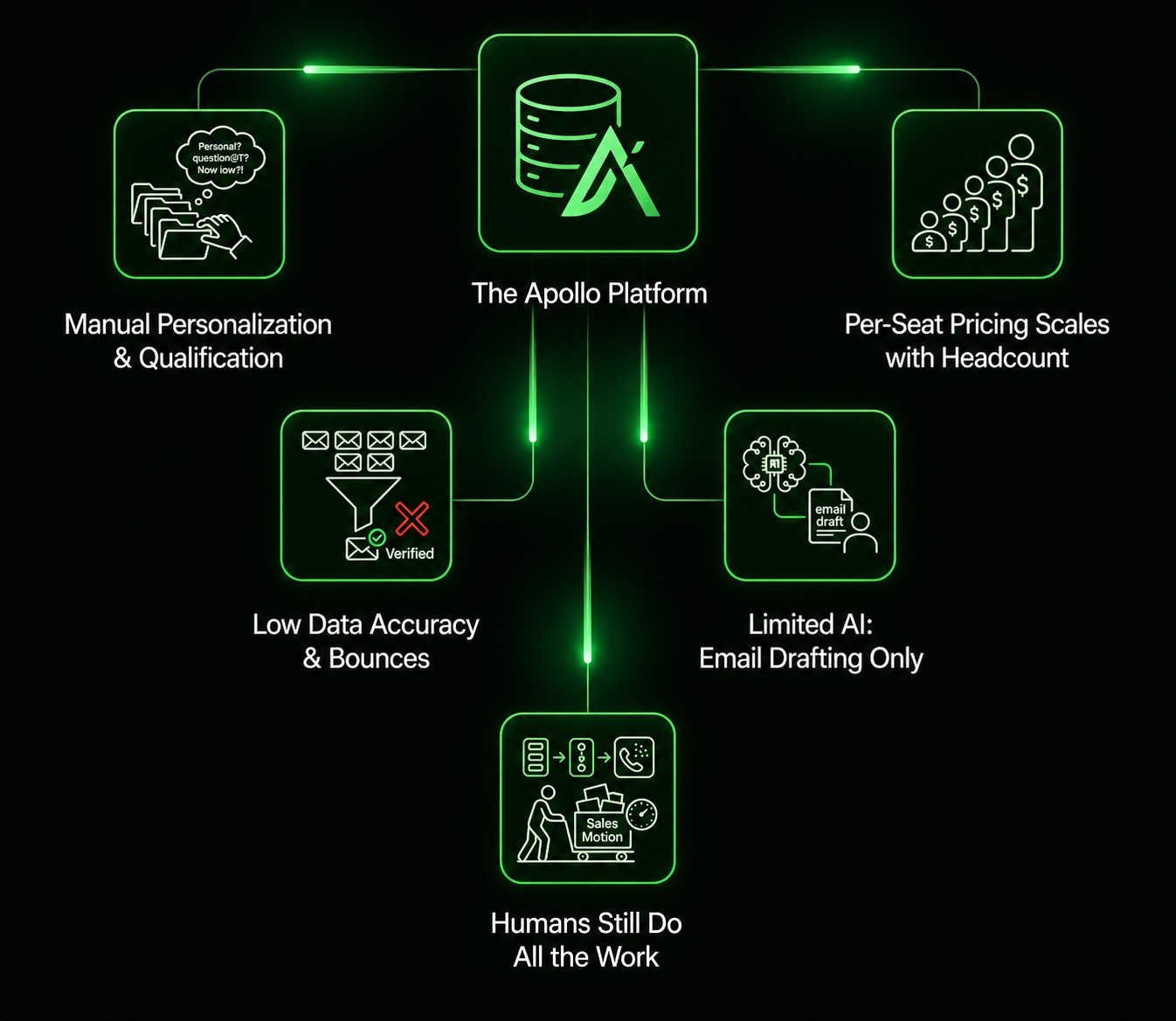
Apollo platform problems

"Apollo gave us 275 million contacts and a sequencer. Turgo gives us five AI employees that actually run the campaigns."

The problem with Apollo

Apollo gives you contacts.
Humans still do all the work.

Apollo is a strong tool — a database paired with a sequencer and a basic dialer. But the work, the personalization, the qualification, the follow-up timing — all of that lives with your team.

Data accuracy is the headline problem

Apollo advertises 275M contacts. Apply the Verified Emails filter — the database drops to ~96M. ~65% lack verified emails. Bounce rates erode your sender reputation.

Per-seat pricing scales linearly with headcount

Apollo Pro is $99/user/month. A team of 20 SDRs is $23,760 annually before add-ons. Costs compound as you scale, not the value created.

AI is limited to email drafting

Apollo's AI helps write emails for humans to review and send. It doesn't run the motion — it's a feature bolted onto headcount, not a replacement for it.

Head to head

A direct, dimension-by-dimension
look at what each delivers

Dimension
turgo.aiAutonomous AI platformRecommended
Apollo.ioDatabase + sequencer
Core Platform
Core approach
How the platform fundamentally works
Autonomous AI agents
execute the work
Database + sequencer
reps execute the work
Marketing scope
Channels and functions covered
Inbound + outbound + paid
+ calling + RevOps
Outbound SDR
workflow only
AI capability
Depth of AI automation
5 AI employees run
campaigns autonomously
Basic email drafting
and personalization
Data & Intelligence
Data accuracy
Verified, actionable contact data
Real-time intent signals
across 60M companies
~35% of 275M contacts
have verified emails
Intent signals
Hiring spikes, funding events, tech changes
Live signals across
60M+ companies
Static profile data
no live signals
Execution
Voice calling
Automated outbound calling capability
AI Calling Agent — native
fully autonomous
Basic dialer
human-driven
Campaign launch speed
Time from intent to live campaign
4 minutes from
a single prompt
Hours of manual
setup per campaign
Multi-channel outreach
Email, LinkedIn, WhatsApp, voice
All channels in
one continuous loop
Email + LinkedIn
sequences only
Pricing
Pricing model
How costs scale with growth
Self-serve, outcome-aligned
scales with results not seats
Per-seat $49–$119/user/mo
doubles when you hire
Best for
Ideal customer profile
Teams that want a full
marketing department in software
SMB SDRs running
volume outbound
How turgo solves it

Not one AI assistant.
Five AI employees.

Turgo gives you a full marketing team of five specialized AI employees working in one continuous execution loop — replacing four to seven separate tools.

1

AI Inbound Marketer

  • Traffic + leads
  • Auto content
  • Social posts
  • SEO & GEO
2

AI Outbound Rep

  • 60M companies
  • Live intent
  • Email + LinkedIn
  • Books meetings
3

AI Calling Agent

  • AI voice calls
  • Qualifies leads
  • Books meetings
  • No-show recovery
4

Paid Media Optimizer

  • Live bid tuning
  • Budget shifts
  • Auto decisions
  • Retargeting
5

RevOps Automation

  • CRM updates
  • Pipeline mgmt
  • Deal stages
  • Reports
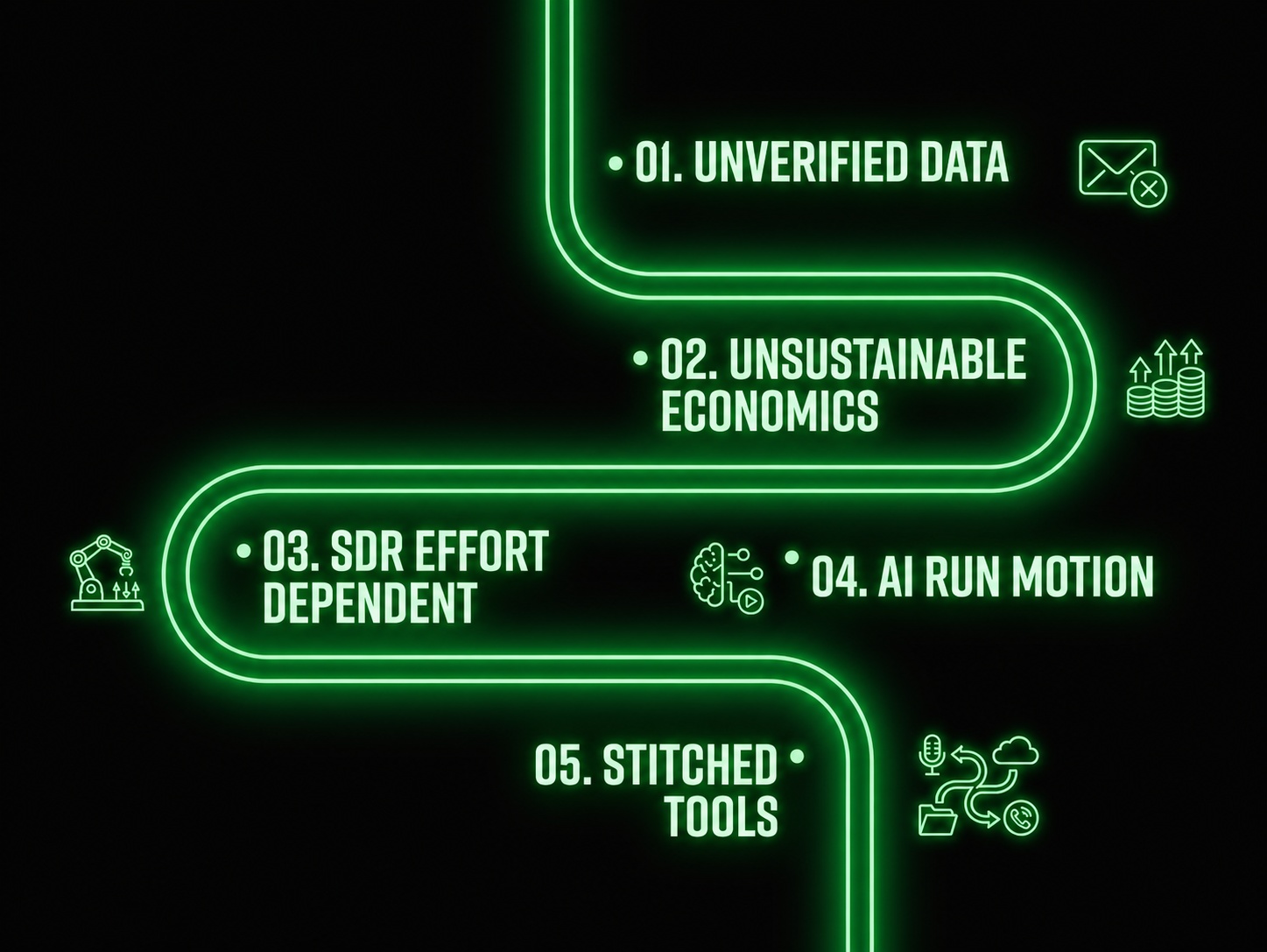
Why teams are switching

Five reasons teams
choose turgo instead

01

Tired of paying for unverified data

Paying for 275M contacts when 65% lack verified emails erodes sender reputation and wastes budget on contacts that bounce.

02

Per-seat economics became unsustainable

SDR team growth made Apollo's per-seat pricing compound in ways that never reflected the actual value being created.

03

Results depended entirely on SDR effort

Outbound results were a function of how hard reps worked, not how good the platform was. Turgo makes the platform do the work.

04

Wanted AI to run the motion, not just assist

Apollo's AI drafts emails for humans to review and send. Teams wanted AI that actually runs the full outbound motion end-to-end.

05

Too many tools stitched together

Voice calling, inbound, and paid media required Apollo plus three other tools. Turgo replaces them all in one continuous execution loop.
"Apollo gave us 275 million contacts and a sequencer. Turgo gives us five AI employees that actually run the campaigns. The difference shows up in our pipeline."
— Customer, B2B SaaS · switched Q1 2025
Five reasons teams choose turgo
Pricing

Scale with outcomes,
not headcount

Turgo's pricing tracks the work being done. Doubling your team doesn't double your platform spend.

Apollo.io
Per-seat pricing
$99
per user / per month · Pro plan
$23,760/yr for a team of 20 SDRs
Costs double when you hire more reps
~65% of contacts lack verified emails
AI assists humans — doesn't replace work
Annual contract typically required
turgo
Outcome-aligned pricing
Self-serve
Outbound Accelerator program · no annual contract
Costs track work done, not team size
Doubling the team doesn't double spend
Real-time intent across 60M+ companies
5 AI employees run the full motion
No annual contract · self-serve sign-up
Questions buyers ask

Turgo vs Apollo: common questions

How accurate is Apollo's contact data?
Apollo advertises around 275 million contacts, but applying Apollo's own Verified Emails filter reduces the database to roughly 96 million — meaning about 65% of records lack a verified email address. That gap matters more than the headline number, because sending to unverified addresses drives bounces, and bounce rate is what erodes your sender reputation and eventually your deliverability. Turgo works from live intent signals across 60 million companies rather than optimizing for raw record count.
How does Apollo's per-seat pricing compare to Turgo's?
Apollo charges per user, from $49 to $119 per user per month, with the Pro plan at $99. A team of 20 SDRs is roughly $23,760 a year before add-ons, and that number doubles when you double the team — the cost scales with headcount rather than with results. Turgo is priced to track the work being done, so growing the team does not multiply the platform bill, and there is no annual contract requirement.
Does Apollo have AI agents?
Apollo has AI features, not AI agents. Its AI drafts and personalizes emails for a human to review and send — a capability layered onto existing headcount. Turgo's five AI employees run campaigns autonomously: sourcing, writing, sending, calling and updating the CRM without a rep in the loop. If your outbound results currently rise and fall with how hard your reps work, that is the difference.
Does Apollo offer real-time intent data?
Apollo targets from static profile data — firmographics and contact attributes — without live buying triggers. Turgo monitors real-time intent across 60 million companies, including funding events, hiring spikes and technology changes, and prioritizes accounts that are in-market now rather than accounts that merely resemble your ICP.
Can Turgo replace Apollo entirely?
For the outbound motion, yes, and for more besides. Apollo covers the SDR workflow: database, email and LinkedIn sequences, and a human-driven dialer. Turgo covers that plus inbound marketing, autonomous voice calling, paid media optimization and RevOps automation — the functions that otherwise require Apollo plus three or four other tools. Teams typically consolidate several contracts rather than swapping one for one.
How fast can each platform launch a campaign?
Turgo can launch a campaign in about four minutes from a single prompt. Apollo requires hours of manual setup per campaign — building the list, writing the sequence, configuring the steps and assigning it to reps. The gap compounds: it is the difference between testing five segments this week and testing one.

Try turgo against
your real ICP.

See your first AI-run campaign in minutes. Self-serve. No annual contract. Outbound Accelerator pricing for early adopters.

ISO 27001 & 42001 CertifiedNo annual contractSelf-serve onboardingLive in under 4 minutes

About Turgo

Turgo.ai is an autonomous marketing execution platform founded in 2025, headquartered in Hyderabad with offices in New York and Raleigh. Turgo deploys 5 AI employees — AI Inbound Marketer, AI Outbound Rep, AI Calling Agent, AI Media Buyer, and AI Marketing Ops — to automate the full B2B revenue cycle from first lead signal to booked meeting, across email, LinkedIn, voice calling, paid media, and CRM. Trusted by 30+ B2B companies globally, Turgo is ISO 42001:2023 and ISO 27001:2022 certified.

Turgo AI - Autonomous GTM Platform
Ready to Automate Your GTM?