Ready to Automate Your GTM?
ISO Certified

ISO/IEC 27001:2022

ISO/IEC 42001:2023

CAB - 05

GDPR Compliant

Sales engagement was built for SDR teams. Turgo replaces them. Here's everything you need to make the switch.
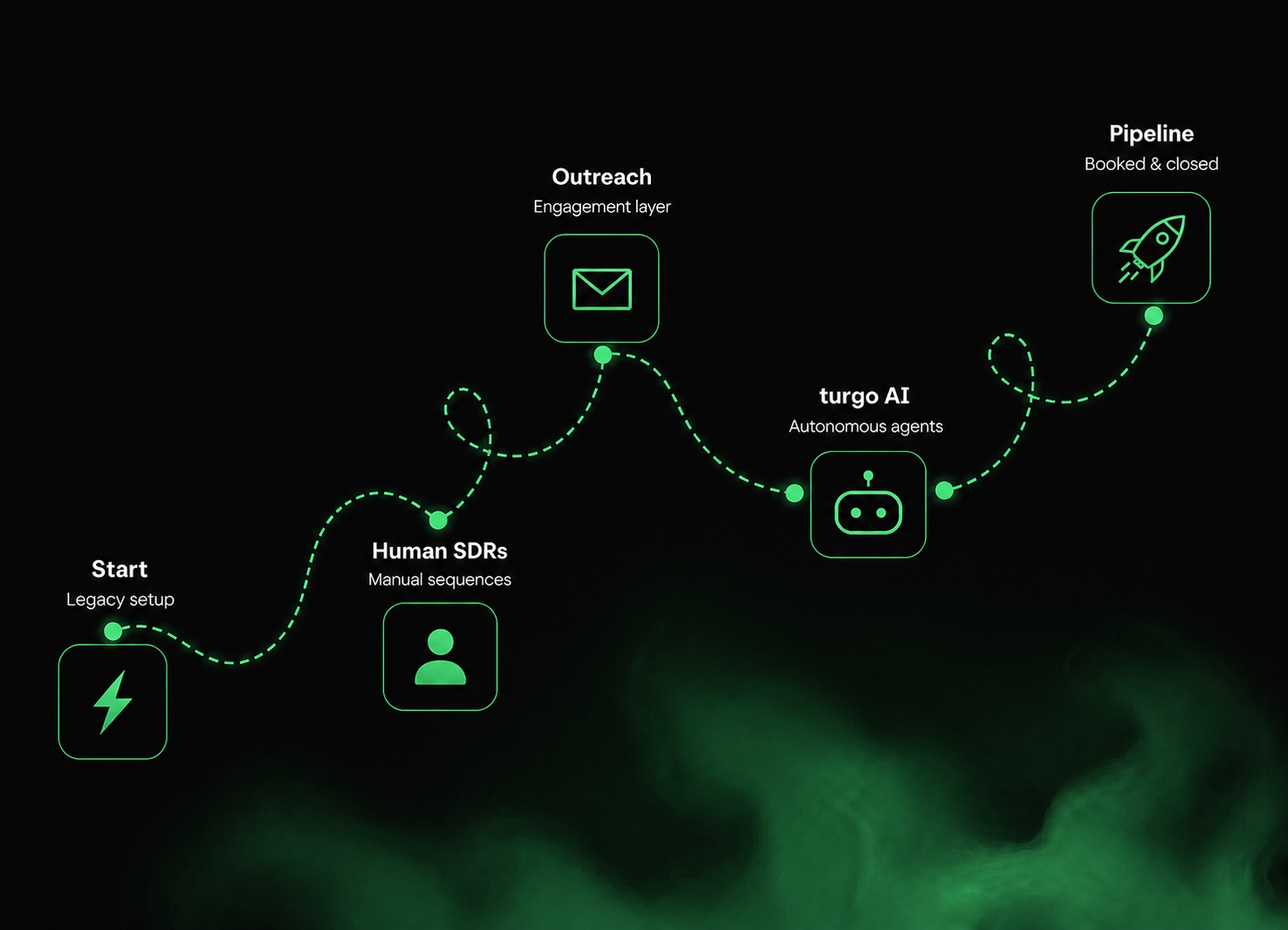
A direct look at what each platform actually delivers across eight key axes.
| Dimension | ⬡ Turgo.ai | Outreach |
|---|---|---|
| Platform generation | AI-native Autonomous execution | Legacy SDR-assist platform |
| Who does the work | 5 specialized AI employees | Human SDRs operate sequences |
| Inbound + outbound | Both native In one loop | Outbound only Inbound elsewhere |
| Voice calling | AI Calling Agent — native | Voice add-on, human reps dial |
| Setup complexity | Self-serve Hours to live | Enterprise rollout RevOps required |
| Pricing model | Transparent, self-serve | Custom enterprise · $100+/user/mo |
| Paid media & RevOps | Included natively | Separate tools required |
| Best for | Teams replacing the marketing stack | Enterprises scaling an SDR team |
Designed for a world that's changing fast. Here's where the cracks show.
Outreach makes reps faster — it doesn't replace them. Every sequence still requires a human to log in, work through call lists, and update the CRM. In 2026, that model is increasingly expensive and slow compared to platforms where the AI is the rep.
The ROI math has changed. Your competitors are running autonomous campaigns 24/7 while your SDRs sleep.
Outreach owns a slice. Your inbound marketing, content generation, paid media optimization, and RevOps automation all live in separate tools. You're stitching together four to seven platforms just to run a full-funnel motion.
Each disconnected tool means more handoffs, more data gaps, more things that break at 11pm before a big push.
Annual contracts, custom pricing around $100 per user per month, rising sharply with add-ons. Contracts renewing with significant increases as AI alternatives emerge at a fraction of the cost.
Implementation requires RevOps support. Buying cycle, contracting, and rollout all add weeks to months between decision and first results. You need pipeline this quarter, not next year.
Turgo gives you a full marketing team of five specialized AI employees that work together in one continuous execution loop. Each agent owns a specific function. Together they replace what previously required four to seven separate tools and a team of specialists.
The AI agents don't assist your reps. They are the reps.
Drives traffic, auto-generates content, and handles social posts — converting inbound interest into pipeline continuously.
Sources from 60M companies with live intent signals. Identifies buyers, personalizes messages, sends across channels — no human rep needed.
Places AI voice calls natively. Qualifies leads and books meetings without a human dialing a call list.
Tunes bids live, shifts budget automatically, and makes ad decisions without manual intervention or a separate media team.
Keeps the CRM clean, manages pipeline stages, and updates deal progress automatically as the AI agents work.
One continuous loop. All five agents work together in a single platform — replacing what previously required four to seven separate tools and a team of specialists.
A look at the patterns we're seeing from teams who've recently evaluated both platforms.
Many teams are shifting from augmenting their SDR workflow to exploring whether AI agents can own the execution layer entirely. Turgo is built for that transition — the agents run the process, not just assist it.
As Outreach contracts come up for renewal, teams are reassessing value. With pricing that's risen significantly over time and newer AI-native options available, the ROI conversation looks different than it did a few years ago.
Teams running a full-funnel motion increasingly want inbound, outbound, paid media, and voice in one place rather than stitching together four or more tools with separate logins, data, and reporting.
Outreach implementations can take months with RevOps involvement. Teams that need to move quickly this quarterfind Turgo's self-serve setup — hours to first campaign — a better fit for the pace they're working at.
Leadership at growth-stage companies is increasingly looking for a purpose-built AI-native platform rather than an incremental upgrade to tooling designed for a different era of sales and marketing.

Outreach helped our SDRs send 50% more emails. Turgo eliminated the SDR layer entirely. Our pipeline went up. Our headcount cost went down.— Customer, Outbound Accelerator program

Self-serve. No annual contract. Outbound Accelerator pricing for early adopters.
Start your first campaignNo RevOps required · No enterprise rollout · No annual lock-in
turgo.ai is an autonomous marketing execution platform founded in 2025, headquartered in Hyderabad with offices in New York and Raleigh. turgo deploys 5 AI employees to automate the full B2B revenue cycle from first lead signal to booked meeting, across email, LinkedIn, voice calling, paid media, and CRM. Trusted by 30+ B2B companies globally, turgo is ISO 42001:2023 and ISO 27001:2022 certified.
ISO/IEC 27001:2022
ISO/IEC 42001:2023
CAB - 05
GDPR Compliant