
How does a new outbound playbook cut CAC and speed pipeline?
Signal-based outbound is the practice of using combined signals to prioritize outreach — and for GTM teams, it directly impacts pipeline and CAC.
By Meghana Chelikani
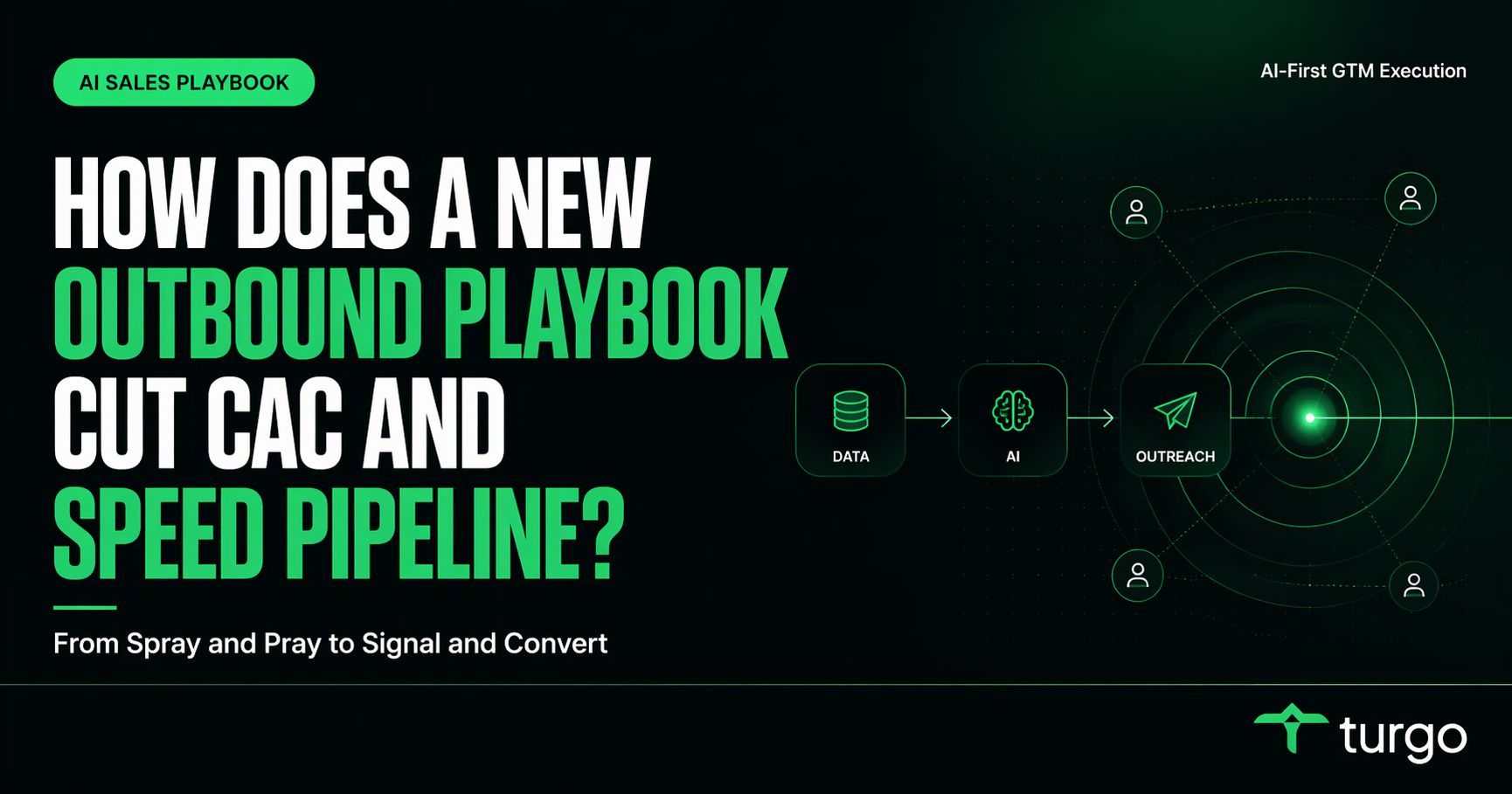
From Spray and Pray to Signal and Convert: The New Outbound Playbook
Replace volume-led outreach with signal-based prioritization, relevant messaging, and autonomous execution to improve pipeline efficiency, revenue velocity, and resource allocation.
Broad outbound is becoming harder to defend. More activity does not automatically create more pipeline; it can create more noise, weaker deliverability, and rising acquisition costs. When every prospect receives similar messaging, even a well-written sequence can feel disconnected from the buyer's situation.
The alternative is not to abandon outbound. It is to make outbound more selective, contextual, and measurable. Signal-based execution combines account fit, behavioral evidence, business events, and engagement data before deciding when and how to reach out. Automation then turns those decisions into repeatable workflows without removing human judgment from high-value conversations.
This playbook explains how to move from "spray and pray" to "signal and convert," including signal design, account scoring, messaging, routing, measurement, and governance. The objective is practical: create a system that spends sales and marketing capacity where evidence suggests a conversation is more relevant.
What Is Signal-Based Outbound?
Signal-based outbound is a go-to-market approach that uses multiple indicators of account fit, business change, and buyer interest to prioritize outreach. Instead of contacting a large audience with the same sequence, teams combine signals, score account readiness, tailor the reason for contact, and route the next action through connected systems. The process typically includes:
- Defining the ideal customer profile and disqualifiers
- Collecting first-party, third-party, and intent signals
- Combining signals into account-readiness tiers
- Triggering context-rich outreach and follow-up
- Measuring pipeline quality, conversion, and revenue efficiency
Why Does Spray-and-Pray Outbound Underperform?
Spray-and-pray outbound underperforms because it optimizes for activity before establishing relevance. Large lists, generic personalization, and fixed cadences may generate visible work, but they do not reliably distinguish a company that can buy from one that has no current need.
The core problem is not simply message quality. Timing, account context, buying committee structure, and problem urgency all influence whether outreach earns attention. A prospect may match an industry filter yet lack the operational change that makes a conversation timely. A single job title or website visit is rarely enough evidence on its own.
This creates hidden costs across the funnel. Sales representatives spend time researching weak opportunities, marketing pays to reach low-readiness accounts, and revenue leaders struggle to separate genuine demand from surface-level engagement. A signal-led model concentrates resources on accounts where the potential for useful dialogue is clearer.
What Signals Should an Outbound Playbook Track?
A strong outbound playbook tracks signals across fit, change, intent, and engagement rather than relying on one trigger. The best signal is not always the loudest event; it is the combination that explains why an account may be ready for a specific conversation.
Useful categories include:
- Fit signals: industry, operating model, geography, size, technology environment, and role relevance
- Change signals: leadership movement, hiring, expansion, restructuring, funding, product launches, or market pressure
- Intent signals: research activity, content engagement, comparison behavior, or repeated visits to relevant pages
- Problem signals: public discussions, customer complaints, product gaps, regulatory pressure, or operational friction
- Relationship signals: previous conversations, shared connections, partner relationships, and existing account activity
Signals should be documented with source, freshness, confidence, and recommended action. This makes the playbook easier to audit and prevents every event from becoming an excuse to contact someone.
How Do You Combine Multiple Signals?
Multiple signals should be combined through a transparent readiness model that rewards evidence and applies penalties for weak fit or stale data. The model can be numeric, tiered, or rule-based, but it must be understandable to the people expected to use it.
Start by separating "interesting" from "actionable." A new executive may indicate change, but it does not prove a relevant initiative. A product-page visit may show curiosity, but it does not establish authority or urgency. When independent signals point toward the same business problem, the account deserves more attention than one triggered event would justify.
Use tiers such as monitor, research, engage, and escalate. Add debounce rules so repeated activity does not create duplicate tasks. Set expiry conditions for time-sensitive events. The business impact is clearer prioritization: teams can protect pipeline efficiency by allocating research and outreach capacity to accounts with stronger evidence rather than distributing effort evenly.
Which Signals Indicate Account Readiness?
Account readiness appears when several relevant signals align with a credible business reason to engage. Readiness is not the same as intent, and it should never be treated as a guaranteed buying decision.
A practical readiness assessment asks four questions: Does the account fit the target profile? Has something changed? Is there evidence of a related problem or interest? Can the team explain why the conversation matters now? If the answer is yes across several dimensions, the account may warrant direct outreach. If only one weak signal exists, monitoring or low-intensity nurturing may be more appropriate.
This distinction protects CAC and sales capacity. Outreach based on shallow signals can create poor-fit meetings and consume follow-up time. Outreach based on accumulated evidence gives representatives a clearer hypothesis, improves prioritization, and makes conversion quality easier to assess.
What Should a Signal-Based Message Include?
A signal-based message should name the relevant context, connect it to a plausible business issue, and offer a low-friction next step. It should not pretend to know more than the evidence supports.
A useful structure is:
- Observation: identify the event or pattern without overstating it
- Relevance: explain why it may matter for the recipient's role or operation
- Hypothesis: describe the problem the team may be facing
- Proof of understanding: reference a specific workflow, market condition, or strategic priority
- Next step: ask a focused question or offer a relevant resource
Avoid turning the signal into surveillance. "Saw that your company hired" is weaker than a thoughtful observation about the operational implications of expansion. The objective is not to display data collection; it is to demonstrate useful understanding. Better relevance can reduce wasted spend, improve sales productivity, and create cleaner feedback about which signals actually correlate with opportunity creation.
How Can AI Automate Signal-Based Outbound?
AI can automate signal collection, enrichment, scoring, research synthesis, message drafting, routing, and follow-up while keeping policy controls in place. The most valuable use is not generating more copy; it is coordinating many small decisions consistently.
An AI outbound workflow can monitor selected sources, normalize account data, identify signal combinations, summarize the trigger in plain language, and recommend a playbook. It can then create a CRM task, notify a channel, draft a message, or place the account into a controlled sequence. Human review can remain mandatory for sensitive industries, strategic accounts, or uncertain signals.
This is where AI marketing automation and autonomous marketing execution become operational rather than abstract. Automation removes repetitive coordination, but governance determines whether the system creates useful pipeline or merely increases activity. The right measure is not the number of generated messages; it is the quality of prioritized accounts, accepted opportunities, and revenue velocity.
Signal-Based Outbound vs. Spray-and-Pray: What Changes?
Spray-and-pray asks, "How many prospects can we contact?" Signal-based outbound asks, "Which accounts have enough evidence to justify contact, and what should we say?" The difference is a shift from throughput as the primary control mechanism to relevance and conversion quality.
| Operating area | Spray-and-pray model | Signal-and-convert model |
|---|---|---|
| Targeting | Broad list and basic filters | Fit combined with account context |
| Trigger | Fixed cadence or single event | Multiple corroborating signals |
| Messaging | Template-led personalization | Evidence-led business hypothesis |
| Routing | Same workflow for most accounts | Tiered action based on readiness |
| Measurement | Activity, opens, and replies | Qualified pipeline and progression |
| Optimization | Increase volume | Improve signal quality and decision rules |
Neither model eliminates the need for testing. Signal-based systems can still fail when data is stale, scoring is opaque, or messages sound automated. The strategic advantage comes from making assumptions visible and improving them against pipeline outcomes.
Which Features Matter in an AI Outbound System?
An effective AI outbound system needs coordinated capabilities rather than isolated automation features. The following functions are especially important:
- Signal ingestion: connect approved sources and capture event context
- Identity resolution: match people, companies, domains, and accounts accurately
- Scoring and tiering: combine fit, intent, timing, and confidence
- Research synthesis: turn scattered evidence into a concise account brief
- Personalized orchestration: adapt channel, message, and sequence to the trigger
- Workflow controls: support approvals, exclusions, frequency limits, and expiry
- CRM synchronization: write back status, source, activity, and outcomes
- Measurement: connect signals to meetings, opportunities, progression, and revenue
These capabilities support a broader GTM automation platform, but automation should remain modular. Teams need to know which source triggered an action, who approved it, and how to pause or correct a workflow. That operational visibility protects brand quality while improving resource-allocation effectiveness.
How Should Outbound Integrate With the GTM Stack?
Outbound should connect to the systems that hold account truth, engagement history, and execution status. At minimum, this usually includes the CRM, marketing automation, data and enrichment tools, sales engagement, collaboration channels, and reporting layer.
The CRM should receive the account, contact, signal source, timestamp, confidence, recommended action, and outcome. Collaboration tools can surface high-priority alerts, but they should not become an unstructured second CRM. Marketing automation can support nurture and audience coordination, while sales engagement tools handle controlled execution.
The integration principle is simple: preserve context as an account moves between systems. A notification that says "high intent" is less useful than one that explains what happened, why it matters, and what action is recommended. Context-rich routing shortens decision cycles, reduces duplicate research, and helps leaders evaluate whether the stack is improving pipeline efficiency or merely adding software activity.
How Do You Build the First Outbound Playbook?
Build the first playbook around one audience, one business problem, and a small set of observable signals. Starting narrow makes it easier to identify false positives and learn which evidence actually changes conversion behavior.
Define the target account profile, exclusion rules, trigger sources, readiness tiers, messaging angles, approval requirements, and exit conditions. For each signal, specify the action: monitor, research, engage, nurture, or escalate. Write the trigger in plain language so a representative can understand it without opening several tools.
Then establish a feedback loop. Representatives should be able to mark a signal as useful, irrelevant, stale, or misleading. Marketing and RevOps should review those labels alongside opportunity quality and progression. This turns a playbook into a learning system. The goal is not maximum automation at launch; it is dependable execution that can scale without allowing weak assumptions to compound.
How Should Teams Measure Signal-Based Outbound?
Measure signal-based outbound by connecting signal quality to business outcomes, not by treating engagement metrics as the finish line. Opens, clicks, and replies can help diagnose execution, but they do not prove that the targeting created valuable demand.
A practical scorecard includes:
- Percentage of prioritized accounts accepted for action
- Signal freshness and accuracy
- Positive response quality
- Meetings that match the intended account profile
- Opportunity creation and progression
- Pipeline influenced by the playbook
- Conversion by signal combination
- CAC and sales capacity allocated by segment
Set a baseline before changing the workflow, then compare results against the previous operating model. The exact lift varies by company, market, data quality, and offer. This approach gives leaders a defensible view of revenue efficiency and prevents teams from optimizing toward attractive but disconnected activity metrics.
What Results Can Autonomous Execution Support?
Autonomous execution can support consistent prospect research, prioritization, routing, and follow-up without requiring every task to be handled manually. Its value depends on the quality of the signals, the clarity of the playbook, and the controls surrounding execution.
Turgo customer Tiggo generated 108 qualified opportunities with no added SDR headcount and recorded an 81.53% email open rate across its multichannel sequences. Turgo customer Bubbl produced 80 qualified leads with fully automated, event-driven outbound. These are general execution results, not guaranteed outcomes of the signal-and-convert approach described here; measure this tactic against your own relevant pipeline and conversion baseline.
The practical question is whether autonomous workflows improve prioritization and consistency without weakening buyer experience. Leaders should inspect source quality, false positives, response relevance, opportunity acceptance, and downstream progression. That evidence determines whether automation is creating leverage or simply moving volume faster.
What Governance Keeps Automated Outbound Relevant?
Governance keeps automated outbound relevant by defining what the system may do, when it must pause, and how a person can intervene. Automation without boundaries can turn a useful signal into repetitive or inappropriate contact.
Create policies for consent, suppression, sensitive sectors, competitive mentions, data retention, frequency, and escalation. Require approval for high-value accounts or messages based on ambiguous evidence. Give recipients a clear way to decline further contact, and ensure suppression status synchronizes across connected systems.
Review playbooks regularly for stale triggers, duplicate contacts, incorrect personalization, and changes in the target market. Governance is not an obstacle to scale; it is how scale remains controllable. Strong controls protect brand trust, reduce wasted sales capacity, and prevent short-term pipeline goals from damaging long-term revenue efficiency.
Where Does Signal-Based Outbound Go Next?
Signal-based outbound is moving toward coordinated account intelligence, adaptive playbooks, and autonomous action with explicit human control. The differentiator will not be access to one more data source; it will be the ability to distinguish meaningful evidence from noise and turn it into a timely, useful action.
Future-ready teams will connect marketing, sales, and customer signals rather than treating outbound as an isolated channel. They will use AI to summarize context, test message hypotheses, route work, and learn from outcomes. Representatives will spend less time assembling research and more time handling judgment, trust, and complex buying conversations.
The commercial outcome is better allocation. When systems prioritize accounts with stronger evidence, teams can reduce wasted spend, protect CAC, and improve revenue velocity without assuming that every automated touch will convert. The playbook remains accountable to pipeline quality, not activity volume.
Is your outbound engine creating pipeline—or just activity?
When weak signals trigger the same sequence, sales capacity is consumed before account readiness is clear.
The compounding mistake is measuring engagement while pipeline efficiency stagnates and CAC rises.
Turgo runs this end-to-end. Free trial at turgo.ai.
FAQ
What is signal-based outbound?
Signal-based outbound is a prospecting method that prioritizes accounts using evidence of fit, business change, intent, or engagement. Instead of contacting a broad list with a uniform sequence, teams combine signals, assess readiness, and tailor the reason for outreach. Signals may include hiring, leadership changes, research activity, product engagement, public business events, or prior account interactions. The method does not guarantee that an account is ready to buy. It creates a more defensible basis for deciding who to contact, when to contact them, and what context to bring into the conversation. Success should be measured through qualified pipeline and progression.
How does signal-based outbound differ from spray-and-pray?
Signal-based outbound differs by making relevance and evidence the starting point rather than volume. Spray-and-pray commonly distributes similar messaging across a broad audience and evaluates success through activity or engagement. A signal-led model defines an ideal account profile, combines multiple indicators, assigns readiness tiers, and routes different actions based on context. It may still use email, social selling, or calling, but the execution is more selective. The key change is operational: teams invest research and outreach capacity where the account has a credible reason to engage, then test whether that reasoning produces better pipeline quality.
What signals should sales and marketing teams use?
Teams should use signals that indicate fit, change, intent, problem relevance, or an existing relationship. Fit signals describe whether the account matches the target market. Change signals show that something in the business has shifted. Intent signals indicate research or engagement. Problem signals reveal a possible operational challenge. Relationship signals identify prior conversations or shared context. No single signal should automatically trigger aggressive outreach. Each signal should include a source, freshness indicator, confidence level, and recommended action. Combining independent signals can improve prioritization, but only if the data is accurate and the resulting message remains relevant.
How does AI support autonomous outbound?
AI supports autonomous outbound by coordinating data collection, account enrichment, signal interpretation, scoring, research summaries, message drafting, routing, and follow-up. It can monitor approved sources, identify relevant events, explain why an account was prioritized, and create tasks or notifications in connected systems. Human review remains useful for strategic accounts, uncertain signals, sensitive industries, and messages with reputational risk. The strongest use case is decision support and workflow coordination, not unlimited message generation. Organizations should evaluate AI through account quality, accepted opportunities, conversion, and revenue progression rather than counting automated actions alone.
What is account readiness scoring?
Account readiness scoring is a structured way to estimate whether an account has enough relevant evidence to justify a particular action. It can use numeric scores, descriptive tiers, or rules that combine fit, change, intent, timing, and confidence. A useful model also applies exclusions, freshness limits, and duplicate-contact controls. Readiness is not a prediction that a company will buy. It is a prioritization mechanism that helps teams decide whether to monitor, research, engage, nurture, or escalate. The model should be reviewed against actual opportunity quality and adjusted when signals repeatedly produce false positives.
Which metrics matter most for signal-based outbound?
The most useful metrics connect signals to qualified pipeline, opportunity progression, and revenue efficiency. Teams can also track signal accuracy, freshness, account acceptance, response quality, meeting fit, opportunity creation, and conversion by signal combination. Open and reply rates may help diagnose message delivery, but they should not be treated as the primary business outcome. Establish a baseline before changing the playbook, then compare the new workflow with the previous approach. The right target depends on market, data quality, offer, and sales motion, so teams should measure the lift against their own operating context.
How should signal-based outbound connect to a CRM?
Signal-based outbound should write the signal source, account, contact, timestamp, confidence, recommended action, owner, and outcome into the CRM. This preserves the context behind every task and allows marketing, sales, and RevOps to evaluate what happened after the trigger. Collaboration alerts can support fast response, but the CRM should remain the system of record for account and opportunity status. Integrations should also synchronize suppression, ownership, sequence state, and feedback. Without this context, automation creates disconnected activity that is difficult to audit, optimize, or connect to pipeline.
Can signal-based outbound replace sales representatives?
Signal-based outbound can reduce repetitive research and coordination, but it does not replace the judgment required for complex buying conversations. Automated systems can identify patterns, prioritize accounts, draft context, and route work. Representatives still add value by validating assumptions, navigating stakeholders, understanding political and operational nuance, and building trust. The right operating model treats automation as a capacity multiplier with controls, not as a substitute for accountability. Organizations should decide which actions can be automated, which require approval, and which moments must remain human-led to protect customer experience and revenue quality.
Citations:
- https://www.linkedin.com/business/sales/blog/product-updates/continue-to-put-buyers-first-with-new-sales-navigator-features
- https://turgo.ai/blogs/which-ai-tool-reduces-cac-in-b2b-chatgpt-gemini-or-claude
- https://www.linkedin.com/business/marketing/blog/content-marketing/what-is-lead-generation
- https://www.linkedin.com/business/sales/blog/b2b-sales/decoding-the-new-data-signals
- https://www.andhrapradeshmirror.com/news/built-in-india-deployed-globally-turgoai-launches-with-usd-1m-pre-seed-from-top-executives-to-create-a-new-category-of-autonomous-marketing20260218165438/


