
How can sales navigator intent data lift pipeline velocity?
Hiring-signal account identification is using hiring activity to prioritize accounts — and for GTM teams, it directly impacts pipeline velocity and CAC.
By Thota Jahnavi
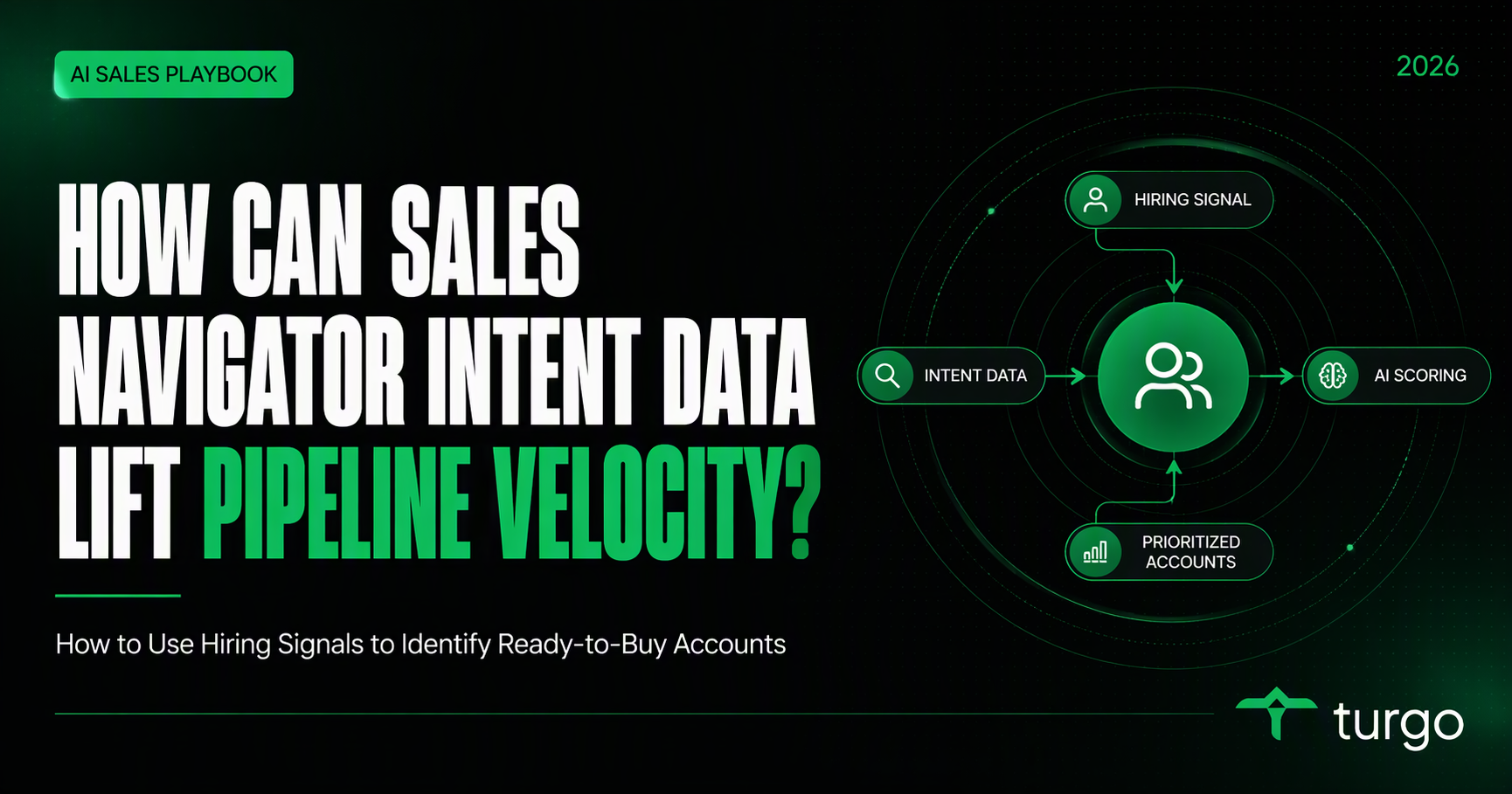
How to Use Hiring Signals to Find Ready-to-Buy Accounts
Turn hiring activity into a practical sales signal. Learn how to combine job postings, ICP fit, buyer mapping, and automation to improve pipeline efficiency without chasing noise.
Hiring signals can reveal when an account is investing in a team, entering a new market, or preparing to operationalize a business priority. A company hiring sales operations leaders, security engineers, or revenue executives may be creating the conditions that make a relevant solution more valuable.
But hiring alone is not buying intent. A job posting can remain open for months, reflect routine replacement hiring, or have little connection to your offer. The commercial advantage comes from treating hiring as one signal in a broader system: combine role relevance, company fit, recency, buyer mapping, and corroborating activity before prioritizing outreach.
For growth teams, this creates a more disciplined alternative to generic prospecting. Instead of asking only which companies match the ideal customer profile, the team can also ask which accounts are changing in ways that make a conversation timely.
What Is Hiring-Signal-Based Account Identification?
Hiring-signal-based account identification uses job postings, hiring announcements, leadership changes, and team expansion patterns to identify accounts that may be entering a relevant buying window. The method combines hiring activity with ICP fit, role relevance, account research, and other intent data to prioritize outreach rather than treating every open position as a sales opportunity.
Key components include:
- Role-specific hiring connected to a business problem
- Recency and persistence of the hiring activity
- Company fit based on industry, size, geography, and operating model
- Mapping of likely decision-makers and workflow owners
- Corroborating signals such as partnerships, research activity, or engagement
Why Do Hiring Signals Matter in B2B Sales?
Hiring signals matter because they show that an organization is allocating attention and resources to a particular capability. When a company recruits for a function related to your product, it may be formalizing a process, expanding capacity, or addressing an operational gap.
The signal is strongest when the role reflects a problem your solution can help solve. A company hiring several demand-generation professionals may be reviewing its marketing infrastructure. A business recruiting implementation specialists may be preparing for customer or operational expansion. The role does not prove budget or intent, but it gives outreach a more relevant reason to exist.
This improves pipeline efficiency by helping teams focus research and personalization on accounts with visible change. It can also support better CAC discipline: resources go toward accounts with a plausible timing trigger instead of being distributed evenly across a static list.
Which Hiring Signals Indicate Sales Intent?
The most useful hiring signals are role-specific, recent, and connected to a business priority your solution addresses. Signals become more meaningful when they appear alongside organizational change, expansion, or other evidence of active investment.
Look for:
- Hiring for leaders who own the problem your product addresses
- Multiple openings within the same function
- New roles appearing in a previously small or absent department
- Hiring across a new region, segment, or business unit
- Job descriptions mentioning systems, processes, scale, compliance, or transformation
- Public announcements about expansion, partnerships, or organizational change
- A new executive whose remit includes the workflow you support
Avoid treating generic hiring volume as intent. A company may be hiring aggressively while delaying technology purchases, consolidating vendors, or prioritizing unrelated initiatives. The business impact depends on signal quality, not signal volume. Stronger qualification helps protect pipeline velocity from low-fit accounts and reduces wasted sales effort.
How Should Teams Score Hiring Signals?
Teams should score hiring signals using a transparent model that combines fit, role relevance, recency, and corroboration. The purpose is not to create a perfect prediction; it is to make prioritization consistent and explainable.
A practical scoring framework can include:
- ICP fit: Does the account match the market, operating model, and customer profile?
- Role relevance: Does the hiring activity relate directly to the problem being solved?
- Recency: Is the signal current enough to influence outreach?
- Breadth: Is the account hiring one person or building a meaningful function?
- Evidence quality: Is the information from a current job post, company announcement, or another reliable source?
- Corroboration: Are there complementary signals such as product research, partnership activity, or website engagement?
Keep the model adjustable. If accounts with strong hiring scores rarely progress, reduce the weight of hiring or improve buyer mapping. If they consistently produce productive conversations, increase their priority. The goal is more efficient allocation of research and outreach capacity, not a false appearance of predictive certainty.
What Does a Hiring-Signal Workflow Look Like?
A hiring-signal workflow moves from detection to validation, prioritization, enrichment, and action. Each step should have a clear purpose and an owner so automation accelerates execution without removing judgment.
A practical workflow is:
- Define the roles and hiring language connected to your offer.
- Monitor company career pages, professional networks, job boards, and approved data providers.
- Match each signal to a known account record.
- Check ICP fit and remove obvious mismatches.
- Score role relevance, recency, and corroborating activity.
- Map the likely budget owner, operational owner, and affected stakeholders.
- Create a concise account brief explaining why the account was prioritized.
- Route the account to a research queue, sales sequence, or human review.
- Record the outcome and use it to refine scoring.
This is where GTM automation becomes operationally valuable. Automation can detect changes, update records, and prepare context while the team retains control over messaging and thresholds. That balance supports pipeline velocity without turning noisy signals into indiscriminate outreach.
How Do You Combine Hiring Signals With ICP Fit?
Hiring signals should refine an ICP, not replace it. The account must first meet the baseline conditions that make your product commercially relevant; hiring then helps indicate whether the timing is worth attention.
Start with firmographic and operational criteria such as industry, geography, business model, team structure, and existing technology environment. Then define hiring patterns that indicate a likely need. For example, a role may matter because it owns a process your platform automates, not simply because it has a familiar title.
Use exclusions as deliberately as inclusions. Remove accounts where the role is unrelated, the company is outside your service model, or the signal is too old to support timely action. This prevents sales prediction using AI from becoming a black-box exercise.
The commercial result is a better balance between account quality and timing. ICP-only prospecting can create a broad but static market. Hiring-only prospecting can create a timely but poorly qualified list. Combining both improves the probability that limited resources reach accounts with a credible business reason to engage.
How Can Buyer Mapping Improve Hiring-Signal Outreach?
Buyer mapping improves hiring-signal outreach by connecting an organizational change to the people who can evaluate, approve, implement, or influence a solution. The person associated with the job posting is not always the buyer.
Map at least three stakeholder types:
- The executive accountable for the outcome
- The functional leader who owns the workflow
- The practitioner who may use or influence the solution
Then research how responsibilities are distributed. A newly posted revenue operations role may report to a chief revenue officer, collaborate with marketing operations, and depend on sales leadership. Each stakeholder requires a different message.
Avoid relying on titles alone. Confirm the person's current role, functional scope, tenure, and relationship to the hiring activity where possible. A strong account brief should explain both why the company matters and why each contact is relevant.
This makes autonomous B2B outreach more precise. Personalization is not inserting a job title into a template; it is connecting a timely business change to a specific operational consequence. Better relevance can support conversion efficiency while reducing the risk of contacting people who cannot act.
What Should the First Outreach Message Say?
The first message should acknowledge the business change without assuming that the account has already decided to buy. Use the hiring signal as a reason to investigate, not as proof of a problem.
A useful structure is:
- Mention the relevant team or capability being developed
- State the operational issue your product helps address
- Explain why that issue may become more important as the function grows
- Ask a focused question about the current approach
- Offer a low-friction next step only if the context supports it
Avoid saying that the company is "clearly looking for a solution" or that the new hire "must be struggling." Those claims overreach the evidence. Instead, frame the signal as a hypothesis and invite correction.
For revenue teams, this approach supports quality over message volume. The objective is not to force a meeting from every trigger. It is to create a credible conversation that can either advance pipeline or disqualify the account quickly, improving resource-allocation effectiveness.
Hiring Signals vs. Traditional Intent Data: Which Is Better?
Hiring signals and traditional intent data answer different questions. Hiring activity indicates organizational change and potential need, while digital intent data may indicate active research or engagement with a topic, product category, or solution.
Hiring signals are often useful earlier in the buying journey. They can reveal that a company is building capacity before the team searches for vendors. Traditional intent data may provide stronger evidence that an account is researching, comparing, or interacting with relevant content. Neither signal should be treated as a standalone buying decision.
A practical system combines them:
- Use ICP fit to establish relevance
- Use hiring to identify organizational timing
- Use digital intent to assess active research
- Use engagement to evaluate response to your messaging
- Use buyer mapping to identify who can act
This is the difference between signal collection and sales intelligence. The goal is not to purchase every available data source. It is to create a coherent prioritization process that improves pipeline quality without increasing unnecessary CAC pressure.
Which Tools and Integrations Support Hiring-Signal Detection?
A useful hiring-signal system typically connects a signal source, account database, enrichment layer, scoring workflow, CRM, and engagement channel. The exact stack depends on data access, compliance requirements, and how much execution the team wants to automate.
Common components include:
- Public company career pages and professional networks
- Job and company data providers
- Account enrichment and identity resolution
- CRM account and contact records
- Marketing automation and campaign systems
- Workflow automation or AI agents
- Reporting for signal dates, scores, actions, and outcomes
Sales Navigator intent data can be useful when it provides account or buyer context inside a professional-network workflow, but teams should verify what each feature actually measures. Intent data providers also vary in coverage, methodology, freshness, and permitted use.
Integrations should preserve explainability. Store the signal type, source, date, matched account, score rationale, and action taken. That information helps RevOps diagnose data quality and lets sellers understand why an account was prioritized. A connected marketing automation platform is valuable only when it produces usable decisions rather than another stream of unreviewed alerts.
How Can AI Automate Hiring-Signal Analysis?
AI can automate the repetitive parts of hiring-signal analysis: monitoring sources, classifying roles, matching companies, summarizing job descriptions, identifying likely stakeholders, and routing accounts according to defined rules.
The strongest use of AI is structured interpretation. A model can compare a job description with your ICP and solution context, identify relevant responsibilities, and produce a reasoned summary for review. It can also detect changes across an account record and flag when multiple signals appear together.
Human oversight remains necessary. AI may misclassify a role, match a subsidiary to the wrong parent company, miss a stale posting, or infer urgency where none exists. Set confidence thresholds and send uncertain cases to review rather than forcing every account into an automated sequence.
This is the foundation of AI outbound automation: systems perform detection and preparation continuously, while teams govern the rules, claims, and customer experience. The business benefit is not automation for its own sake. It is more consistent prioritization and less manual work between signal discovery and useful action.
How Should Teams Measure Hiring-Signal Performance?
Measure hiring-signal performance by comparing signal-driven accounts with your existing account-selection process. The right question is whether the signal improves prioritization and commercial efficiency for your business, not whether it produces an impressive score.
Track:
- Signal-to-researched-account rate
- Research-to-engagement rate
- Positive response quality
- Meetings that meet qualification criteria
- Account progression into opportunities
- Time from signal detection to action
- Disqualification reasons
- Pipeline influenced by signal-driven prioritization
- CAC and resource use by account tier
Keep the hiring signal separate from other sources in reporting. If an account received hiring, web, partner, and inbound signals, record the combination rather than assigning all influence to one trigger.
Use your own baseline and review results by role type, industry, source, and recency. The exact lift varies by company. Measurement turns sales intent from a conceptual category into an operating discipline and helps leaders decide whether more data, better enrichment, or better execution is the real constraint.
What Are the Main Risks of Hiring-Signal Prospecting?
The main risks are false positives, stale data, weak identity matching, privacy concerns, and over-automated outreach. Hiring activity can be public without being commercially meaningful, and a visible role does not necessarily indicate an available budget.
Reduce risk through operational safeguards:
- Verify that the role is current and connected to the right account
- Record when the signal was observed
- Separate fact from inference in account notes
- Use approved data sources and respect platform terms
- Avoid sensitive personal attributes and unnecessary data collection
- Require review for low-confidence matches
- Cap outreach when multiple signals do not align
- Let prospects opt out and honor suppression rules
Security and access hygiene matter as well. Teams can lose continuity when a platform account, integration, or data source is managed informally.
Risk controls protect more than compliance. They preserve sender reputation, brand trust, and sales capacity. A noisy system can increase activity while weakening pipeline efficiency. A controlled system makes automation accountable to evidence, relevance, and customer experience.
How Do You Turn Signals Into Autonomous Marketing Execution?
Autonomous marketing execution requires more than a trigger and an email sequence. It needs a closed-loop system that detects a signal, evaluates context, chooses an action, records the result, and learns from the outcome.
Design the system around decision tiers:
- Research: signal is interesting but needs validation
- Prioritize: account fits and deserves human review
- Engage: evidence supports relevant, personalized outreach
- Monitor: account remains important but timing is uncertain
- Suppress: signal is stale, weak, duplicated, or outside the ICP
Build replay or demo modes before connecting every workflow to production systems. Test how the process handles duplicate accounts, closed roles, missing contacts, parent-subsidiary relationships, and conflicting signals. Make the score explainable so sellers can see what triggered the account.
A mature GTM automation platform should improve speed without removing control. When the loop is measured against pipeline progression, revenue velocity, and resource use, automation becomes a management system rather than a collection of disconnected tasks.
What Does Good Hiring-Signal Execution Look Like?
Good execution is specific, evidence-based, and connected to a clear operating decision. It does not treat every job post as a reason to contact an account or every account score as a forecast.
Turgo customer Tiggo generated 108 qualified opportunities with no added SDR headcount and recorded an 81.53% email open rate across its multichannel sequences. Turgo customer Bubbl produced 80 qualified leads with fully automated, event-driven outbound. These are general autonomous-execution results, not guaranteed outcomes from hiring signals; measure this tactic against your own account-prioritization and pipeline baseline.
The operating model should make it easy to answer four questions: What changed? Why does it matter to this account? Who owns the relevant decision? What action is justified now? When those answers are visible in the workflow, teams can evaluate whether hiring signals improve pipeline quality, reduce wasted effort, and support more efficient growth.
Is your account prioritization based on change—or habit?
Static lists create a hidden inefficiency: teams keep spending time on accounts whose timing has not changed while newer, higher-relevance signals go unreviewed. That can leave pipeline stagnant and resource allocation misaligned with current demand.
CAC discipline depends on connecting outreach effort to evidence, then measuring whether the evidence improves revenue velocity.
Turgo automates this entire workflow. Try it free at turgo.ai.
FAQ
What is hiring-signal-based prospecting?
Hiring-signal-based prospecting uses company hiring activity to identify accounts that may have a relevant operational need or changing priority. The signal can include job postings, executive appointments, team expansion, or hiring for a function connected to your product.
It is not the same as confirmed buying intent. Hiring should be evaluated alongside ICP fit, role relevance, recency, and other evidence such as research activity or engagement. The best use is prioritization: decide which accounts deserve research and personalized outreach first.
Teams should record the source and date of each signal, explain why it matters, and measure whether signal-driven accounts progress more effectively than accounts selected through their existing process.
How does hiring activity reveal potential buying intent?
Hiring activity reveals potential buying intent by showing that an organization is investing attention in a capability, team, or business priority. A new role may indicate expansion, process formalization, or a need to improve operational capacity.
The connection depends on relevance. Hiring a role related to your product can make a conversation more timely, while unrelated hiring may provide no useful commercial context. Multiple openings or a new leadership function can strengthen the hypothesis, but neither proves budget or urgency.
Use hiring as a trigger for research, not a conclusion. Validate the account, identify the relevant stakeholders, and look for corroborating signals before initiating outreach.
Why do hiring signals need ICP validation?
Hiring signals need ICP validation because an account can show substantial hiring activity and still be a poor fit for your product. Hiring may reflect a different division, geography, business model, or operational requirement than the one you serve.
ICP validation prevents teams from confusing visible activity with commercial relevance. Check the company's industry, size, operating model, technology environment, and customer profile before assigning priority. Then assess whether the specific role connects to a problem your solution addresses.
This protects sales capacity and improves CAC efficiency. Without validation, automation can create a larger prospect list while increasing research burden and lowering the quality of conversations.
What hiring roles are most useful for sales prioritization?
The most useful roles are those with a direct relationship to the problem your product solves or the function that owns the buying decision. These may include executives, functional leaders, operations specialists, technical owners, or implementation roles, depending on the category.
Look for responsibility language in the job description, not just the title. Terms related to scaling, systems, process ownership, compliance, reporting, or transformation can help establish relevance. The same title can represent different responsibilities across companies.
Prioritize roles that are current and connected to a clear business change. Then map the executive sponsor, operational owner, and likely users so outreach reflects the account's decision structure.
How should hiring signals be scored?
Hiring signals should be scored using a transparent combination of account fit, role relevance, recency, evidence quality, and corroborating activity. The score should help teams rank accounts and explain why one account deserves attention before another.
Avoid treating the score as a precise probability of purchase. A score is a prioritization aid, and its usefulness depends on the quality of the underlying data and the way the team acts on it. Store the signal source, date, matched account, and rationale.
Review outcomes by signal type and role category. If a signal rarely leads to meaningful engagement, lower its weight or change the qualification rule. If it helps identify timely accounts, preserve it while continuing to test against your baseline.
Can AI automate hiring-signal detection and outreach?
AI can automate signal monitoring, job-role classification, account matching, summarization, scoring, contact enrichment, and workflow routing. It can also prepare personalized research context for review before an account enters an outreach process.
Human oversight is still necessary because AI can misread job descriptions, match the wrong entity, overlook stale postings, or infer urgency without evidence. Use confidence thresholds, approval steps, suppression rules, and clear audit trails.
The most reliable model is controlled automation. Let systems handle repetitive detection and preparation while people govern messaging, exceptions, and customer-facing claims. This supports scalable execution without turning uncertain signals into indiscriminate outreach.
How do hiring signals compare with intent data providers?
Hiring signals and intent data providers offer different forms of context. Hiring signals show organizational change, while intent platforms may capture research, content engagement, website behavior, or other indicators of active interest.
Hiring can be useful before an account openly researches a category. Other intent sources may provide stronger evidence that a company is currently exploring solutions. Coverage and methodology differ across providers, so teams should verify definitions, freshness, identity matching, and permitted use.
The strongest process combines sources selectively. Use hiring to identify timing, intent data to add behavioral context, ICP scoring to confirm fit, and buyer mapping to determine who should be contacted.
What should teams measure after adopting hiring signals?
Teams should measure whether hiring signals improve account selection and commercial progression relative to their current process. Useful measures include the rate of researched accounts, qualified engagement, meetings, opportunity progression, time from detection to action, and disqualification reasons.
Also track the operational cost of the workflow. A signal that creates many alerts but requires extensive manual review may not improve efficiency. Segment results by role type, source, industry, recency, and signal combinations to find where the approach is genuinely useful.
Do not assume that every opportunity influenced by a hiring signal was caused by it. Record multiple contributing signals and evaluate the tactic against your own baseline so decisions reflect actual pipeline and resource-allocation performance.
Citations:
[1] https://turgo.ai/blogs/how-do-firmographic-technographic-and-intent-data-cut-cac


