
How do AI agents accelerate b2b go to market strategy?
AI-driven GTM is the practice of using AI agents to execute coordinated GTM work — and for GTM teams, it directly impacts pipeline velocity and CAC.
By Thota Jahnavi
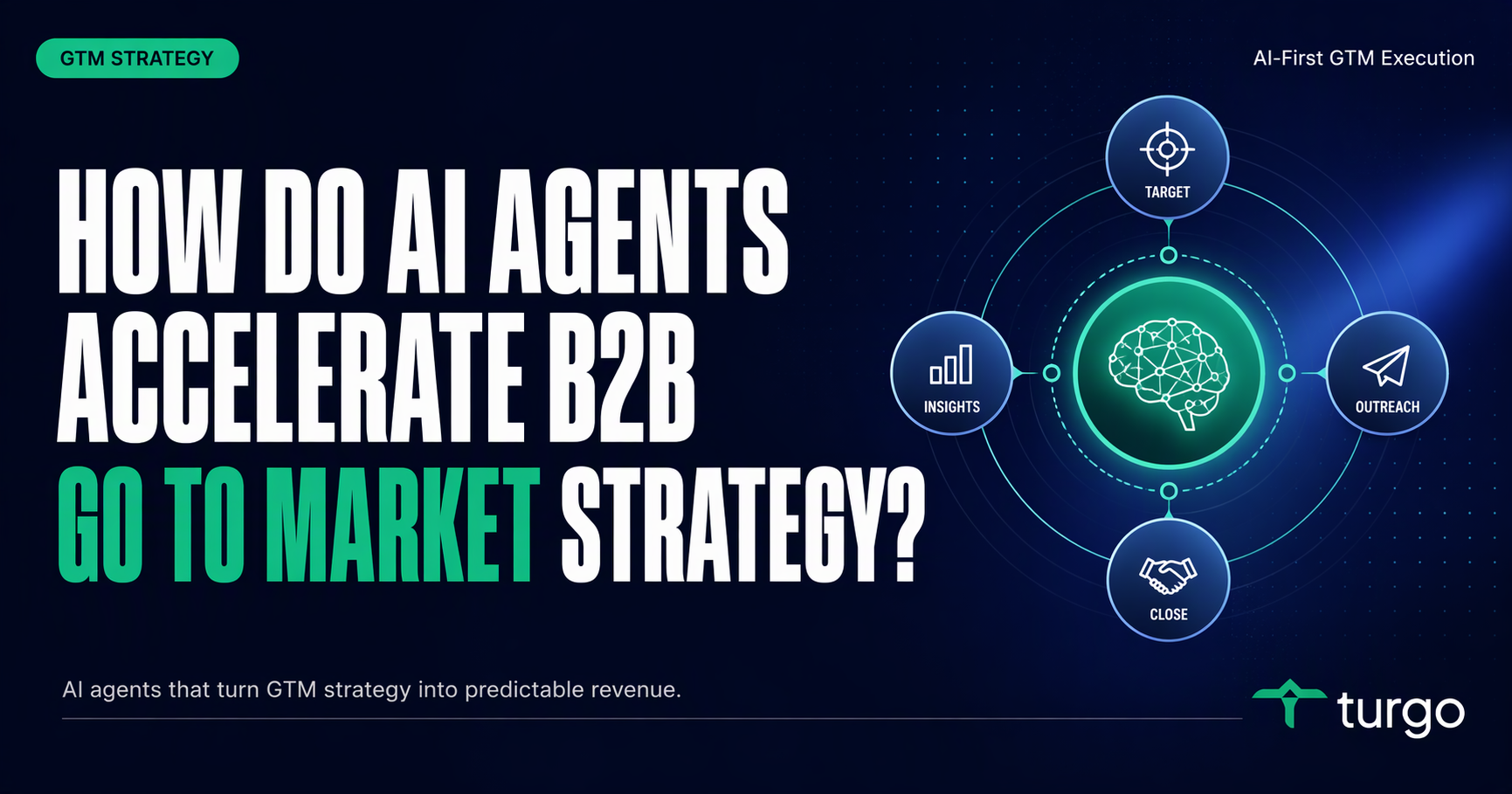
How AI Agents Are Transforming B2B Go-to-Market
AI agents are reshaping B2B go-to-market by connecting research, engagement, qualification, and follow-up into coordinated workflows that operate continuously. See how autonomous execution can improve pipeline efficiency, revenue velocity, and resource allocation without removing human judgment.
B2B go-to-market teams are under pressure to create more pipeline while navigating fragmented data, crowded channels, and limited specialist capacity. The challenge is rarely a lack of strategy. More often, strong plans lose momentum in the handoffs between marketing, sales, RevOps, and customer-facing systems.
AI agents change that operating model. Rather than using AI only to draft copy or summarize calls, teams can deploy agents to interpret signals, decide what should happen next, and complete defined actions across connected systems. The result is a more responsive go-to-market motion—provided the organization sets clear boundaries, reliable data access, and measurable success criteria.
What Is AI-Driven B2B Go-to-Market?
AI-driven B2B go-to-market is the use of artificial intelligence, including autonomous agents, to coordinate how a business identifies accounts, reaches buyers, qualifies demand, supports sales conversations, and learns from outcomes. Agents combine business rules, context, data, and approved actions to complete repeatable GTM work while escalating sensitive decisions to people.
- Account and buyer research
- Audience segmentation and prioritization
- Personalized outbound and inbound engagement
- Lead qualification and routing
- CRM updates, reporting, and workflow orchestration
Why Are AI Agents Changing the GTM Model?
AI agents change B2B go-to-market because they connect decisions with execution. Traditional workflows often depend on a person noticing a signal, interpreting it, opening several systems, and initiating the next step. An agent can monitor approved signals, apply context, and trigger a defined workflow without waiting for a manual handoff.
This does not make strategy irrelevant. It changes where strategic work happens. Leaders define the market, positioning, qualification logic, risk boundaries, and commercial goals. Agents then execute the operational layer with greater consistency across channels and accounts.
The business impact is operational rather than magical. Faster follow-up can protect pipeline velocity, while better prioritization can reduce wasted spend and limit CAC pressure. The relevant question is not whether an agent can perform a task, but whether the task is valuable, repeatable, measurable, and safe to automate.
Which GTM Tasks Should Agents Handle First?
Agents should handle work that is repetitive, rules-based, data-dependent, and easy to review. Strong starting points include account research, enrichment, lead classification, meeting coordination, CRM hygiene, follow-up drafting, and routing based on documented criteria.
The best initial workflow usually sits between marketing and sales. For example, an agent can evaluate an inbound request against firmographic and behavioral context, prepare a concise account summary, assign a priority, and route the record to the correct owner. Human teams retain control over exceptions and high-consequence decisions.
This approach improves resource allocation because specialists spend less time searching, copying, and updating systems. It can also improve pipeline efficiency by reducing avoidable delays. Teams should measure the baseline before automation and track accuracy, acceptance, response quality, qualified pipeline, and conversion—not activity volume alone.
How Do AI Agents Support the Entire Funnel?
AI agents support the funnel by coordinating multiple stages rather than optimizing one isolated channel. At the top, they can identify accounts and organize research. In the middle, they can personalize engagement, answer routine questions, and determine whether a prospect meets qualification criteria. Further down the funnel, they can assist with scheduling, follow-up, and CRM updates.
The value comes from continuity. A useful agent should preserve context as a buyer moves from an ad, website interaction, email exchange, or event response into a sales conversation. Salesforce describes agentic marketing automation as spanning segmentation, multichannel engagement, lead scoring, and sales handoff.[1]
When funnel context is connected, teams can identify where pipeline stagnates and which handoffs create friction. That supports better CAC management because acquisition activity is evaluated alongside progression and conversion. Agents should not be judged solely on messages sent; they should be evaluated on the quality and commercial movement of the opportunities they influence.
What Does AI Outbound Look Like in Practice?
AI outbound combines account selection, research, messaging, sequencing, response handling, and reporting into an orchestrated workflow. Instead of sending the same sequence to a broad list, an agent can use defined account criteria and relevant business context to determine whether outreach is appropriate and what information deserves attention.
A responsible workflow separates preparation from permission. The agent may research an account, recommend a message, and classify a response automatically, while rules determine when a human must review the action. Suppression lists, opt-out handling, frequency limits, approved claims, and escalation paths should be explicit.
The commercial objective is not maximum volume. It is efficient access to higher-fit conversations. Teams should monitor positive response quality, meeting acceptance, qualification accuracy, opportunity progression, and unsubscribes. That makes AI outbound automation a measurable GTM capability rather than an ungoverned sending engine.
How Does AI Inbound Lead Qualification Work?
AI inbound lead qualification uses an agent to interpret incoming requests, gather relevant context, ask approved questions, and route promising opportunities according to the organization's qualification model. It can operate across website forms, chat, email, and other supported entry points while preserving a consistent handoff.
The agent needs more than a score. It needs access to the criteria that define fit, intent, urgency, territory, product eligibility, and routing ownership. Salesforce's agent documentation describes inbound agents that engage, qualify, and convert leads using information across go-to-market systems.[2]
For growth leaders, the impact is tied to response quality and pipeline velocity. An agent may help prevent qualified demand from sitting unassigned, but incorrect qualification can create noise for sales. Measure accepted handoffs, disqualification accuracy, sales follow-up, conversion, and the effect on CAC—not just the number of conversations initiated.
AI Agents vs Traditional Marketing Automation: What Changes?
Traditional marketing automation generally executes predefined triggers, rules, and sequences. AI agents add interpretation, planning, and adaptive action within boundaries established by the organization. The distinction is not that one is automated and the other is manual; both can automate. The difference is how much context the system can use when deciding what should happen next.
Rule-based automation remains valuable for predictable workflows such as reminders, scoring thresholds, and lifecycle updates. Agents are better suited to tasks involving unstructured information, changing context, and several connected steps. They should not replace deterministic controls where consistency and auditability matter most.
A practical GTM stack uses both approaches. Rules protect governance and reliability; agents extend execution into research, personalization, and coordination. This combination can improve resource allocation without forcing every decision into a rigid workflow. The right choice depends on risk, data quality, exception frequency, and the cost of human intervention.
What Should an AI-First GTM Architecture Include?
An AI-first GTM architecture needs a clear system of record, accessible context, defined agent responsibilities, action permissions, and evaluation loops. The architecture should make it obvious what an agent can read, what it can change, and when it must request approval.
Core components include CRM and marketing data, identity and account resolution, communication channels, workflow orchestration, analytics, and governance controls. Integrations should support reliable data movement rather than simply adding another interface. An agent that cannot access current ownership, qualification, or account information will produce inconsistent execution.
This is where a GTM automation platform can create leverage. It coordinates AI marketing automation and sales workflows while preserving operational visibility. Leaders should prioritize traceable actions, permission-aware access, failure handling, and clean rollback procedures. Strong architecture reduces the risk that automation creates hidden CAC through duplicate outreach, poor targeting, or untracked work.
How Do Agents Integrate With CRM and Revenue Systems?
Agents integrate with CRM and revenue systems through approved data connections, APIs, workflow tools, and event-driven triggers. They may read account records, interpret activity, update fields, create tasks, route leads, and notify teams. The integration should preserve ownership and permission logic rather than bypass it.
The CRM should remain a dependable source of commercial truth. Agents can improve its usefulness by maintaining records and adding context, but they should not silently create competing versions of account status, qualification, or opportunity stage. Every automated update needs a clear purpose and an accountable owner.
Connected systems can improve pipeline visibility and reduce administrative drag. They can also amplify bad data if duplicate records, stale fields, or unclear definitions are present. Before deployment, document field ownership, update rules, conflict resolution, audit requirements, and the metrics used to assess pipeline quality and revenue velocity.
What Governance Do AI Agents Require?
AI-agent governance requires defined permissions, human oversight, data controls, quality checks, and an audit trail. Governance should be designed around actions, not only models. An agent that drafts a message presents a different risk from one that changes pricing, contacts a prospect, or modifies an opportunity.
Start with an action inventory. Classify tasks as recommend, prepare, execute, or escalate. Set approval requirements for customer-facing claims, sensitive data, high-value accounts, commercial commitments, and irreversible changes. Also establish rules for consent, suppression, retention, and incident response.
Good governance protects efficiency rather than opposing it. Without controls, false positives and inappropriate outreach can damage trust, increase operational rework, and weaken conversion. Clear boundaries let teams scale autonomous marketing execution while keeping accountability visible. Review agent decisions against accuracy, compliance, customer experience, and pipeline outcomes.
How Should Teams Measure AI-Agent Performance?
Teams should measure AI agents against business outcomes and workflow quality, not output volume. Relevant metrics include qualified pipeline, progression between funnel stages, response quality, conversion, routing accuracy, time spent per workflow, CAC efficiency, and revenue velocity.
Measurement requires a baseline and a comparison method. If an agent is introduced into lead qualification, compare its decisions with established human review and track downstream sales acceptance. If it supports outbound, evaluate account fit, positive responses, meetings held, opportunities created, and opt-outs. The exact lift varies by company, market, data quality, and execution discipline.
A useful scorecard includes three layers: operational metrics, commercial metrics, and risk metrics. Operational measures show whether the agent completed work. Commercial measures show whether that work influenced pipeline. Risk measures reveal errors, unwanted contact, policy violations, and customer dissatisfaction. This prevents teams from confusing automation activity with revenue impact.
Where Do AI Agents Improve GTM Efficiency?
AI agents improve GTM efficiency when they remove repetitive coordination and help teams focus effort on higher-value decisions. They can consolidate account context, prepare next steps, maintain records, personalize routine interactions, and coordinate handoffs across marketing, sales, and RevOps.
The strongest efficiency gains usually come from connected workflows rather than isolated features. A research agent that does not inform prioritization, or a qualification agent that cannot route records correctly, may add complexity without improving execution. Map the workflow end to end before selecting individual capabilities.
Turgo customer Tiggo generated 108 qualified opportunities with no added SDR headcount and recorded an 81.53% email open rate across its multichannel sequences. Turgo customer Bubbl produced 80 qualified leads with fully automated, event-driven outbound. These are general autonomous-execution results, not guaranteed outcomes for every AI-agent use case; measure the specific workflow against its own baseline and relevant commercial metric.
What Are the Main Risks of Agentic GTM?
The main risks are poor data, excessive permissions, inaccurate personalization, unapproved claims, weak consent controls, and unclear accountability. Agents can execute flawed logic consistently, which makes a small configuration problem operationally significant when connected to multiple systems.
Risk management begins with narrowing the scope. Give agents only the data and permissions required for the task. Use approved content libraries, confidence thresholds, review queues, suppression rules, and monitoring. Test edge cases before expanding into broader customer-facing workflows.
Leaders should also account for less visible costs. Duplicate outreach can waste spend and erode brand trust. Incorrect routing can slow pipeline progression. Unchecked CRM changes can distort forecasting and resource allocation. Governance should therefore be reviewed alongside CAC, conversion, pipeline velocity, and customer experience—not as a separate compliance exercise.
How Can Companies Build an AI-Agent GTM Roadmap?
A practical roadmap begins with process discovery, not tool selection. Document the current workflow, handoffs, data dependencies, approval points, failure modes, and commercial objective. Then select one narrow use case where the organization can observe both the agent's actions and the downstream business result.
Next, establish the operating model. Define who owns the workflow, who approves changes, what the agent may do independently, and how exceptions reach a human. Connect only the systems required for the initial scope. Create an evaluation set using real historical examples, while protecting confidential and personal information.
Expansion should depend on evidence, not novelty. Continue when accuracy, adoption, customer experience, and pipeline impact meet the team's standards. Pause when errors are difficult to detect or when the workflow creates more review work than it removes. This disciplined approach supports scalable GTM automation without sacrificing control.
How Will AI Agents Reshape Revenue Teams?
AI agents will shift revenue teams from task ownership toward system ownership. Marketing, sales, and RevOps leaders will spend more time defining decision logic, data standards, escalation policies, and measurement frameworks. Human expertise remains essential for positioning, judgment, negotiation, relationship management, and accountability.
The operating model will become more orchestrated. Specialized agents may handle research, qualification, content adaptation, scheduling, and reporting, while a human team governs priorities and exceptions. The advantage will not come from deploying the most agents. It will come from designing the clearest interactions between people, systems, and automated actions.
For executives, the strategic question is how to improve revenue efficiency without creating a less trustworthy buyer experience. Agents can support that goal when they strengthen relevance, reduce friction, and make handoffs more consistent. They undermine it when automation is measured by activity instead of pipeline quality and customer value.
Is your GTM system scaling—or just creating more activity?
When agents operate without clear ownership, hidden inefficiency accumulates across routing, follow-up, and CRM maintenance. Pipeline stagnation can look like a demand problem when the real issue is resource allocation and inconsistent execution.
The trade-off is not automation versus control; it is controlled execution versus unmeasured waste.
Turgo automates this entire workflow. Try it free at turgo.ai.
FAQ
What is an AI agent in B2B go-to-market?
An AI agent is a software system that interprets context, decides among approved next steps, and performs defined GTM actions. Unlike a basic content assistant, an agent can coordinate several tasks, such as researching an account, classifying a lead, preparing outreach, updating a CRM, and escalating an exception.
Agents still require instructions, data access, permissions, and evaluation. They do not replace commercial strategy or human accountability. Their value depends on whether the workflow is clearly defined and connected to reliable systems. Teams should begin with bounded tasks where errors can be detected and business impact can be measured through pipeline quality, conversion, revenue velocity, or resource efficiency.
How do AI agents improve a B2B go-to-market strategy?
AI agents improve a B2B go-to-market strategy by connecting strategic intent with consistent execution. They can help identify target accounts, personalize engagement, qualify demand, coordinate handoffs, and maintain operational data.
The strategic benefit comes from reducing friction between decisions and actions. A defined market strategy becomes more useful when the organization can apply its account criteria, messaging rules, and qualification logic across workflows without relying on manual repetition. Agents do not determine product-market fit or positioning by themselves. Leaders must define those inputs and review outcomes. Measure improvement through accepted leads, opportunity progression, conversion quality, CAC efficiency, and revenue velocity rather than activity volume.
What is the difference between AI agents and marketing automation?
AI agents interpret context and select among approved actions, while traditional marketing automation generally follows predefined triggers, rules, and sequences. Both can be useful, and neither should be treated as a universal replacement for the other.
Rule-based automation works well when the desired behavior is predictable and auditable. Agents are more useful when workflows involve unstructured information, changing context, and several connected steps. A mature GTM system often combines them: rules provide control and consistency, while agents handle research, personalization, coordination, and exception-aware execution. The right balance depends on data quality, task risk, workflow complexity, and the level of human review required.
How should a company choose its first AI-agent use case?
A company should choose a first use case that is repetitive, measurable, bounded, and connected to a real commercial constraint. Lead qualification, account research, meeting coordination, follow-up preparation, and CRM maintenance are common candidates because their inputs and outputs can be reviewed.
Avoid beginning with workflows that involve sensitive commitments, ambiguous ownership, or irreversible customer-facing actions. Define the baseline, success metrics, approval rules, data requirements, and escalation path before deployment. The goal is not to demonstrate that an agent can act; it is to determine whether the action improves pipeline quality, revenue velocity, CAC efficiency, or resource allocation without creating unacceptable operational risk.
Can AI agents replace B2B marketing and sales teams?
AI agents are unlikely to replace the judgment and accountability required from B2B marketing and sales teams. They can replace or reduce portions of repetitive work, but strategy, positioning, negotiation, relationship development, and exception handling remain human-led responsibilities.
The more realistic shift is a change in team composition and operating rhythm. People may spend less time researching records, writing routine follow-ups, or maintaining fields, and more time reviewing priorities, managing important conversations, and improving the system. This can increase productivity only when agents are governed well. If automation produces inaccurate qualification or poor buyer experiences, teams may spend more time correcting work instead of creating value.
How do AI agents affect CAC and pipeline efficiency?
AI agents can affect CAC and pipeline efficiency by improving prioritization, reducing manual coordination, and helping teams respond consistently to relevant demand. They may also increase costs or create waste when targeting, data, permissions, or measurement are weak.
The effect varies by business model, sales cycle, data quality, and workflow design. Track the full path from acquisition through qualification, opportunity creation, progression, and conversion. Include negative signals such as irrelevant outreach, duplicate records, rejected handoffs, and rework. A lower activity cost is not necessarily better if pipeline quality declines. Compare the agent-assisted workflow with the existing baseline using the commercial metrics that matter to the organization.
What integrations do AI agents need for B2B GTM?
AI agents typically need access to the systems that contain account, buyer, activity, ownership, communication, and opportunity context. Depending on the workflow, that may include a CRM, marketing automation platform, enrichment source, communication tools, scheduling, analytics, and internal knowledge repositories.
Integration should be purposeful. Connecting more systems does not automatically create better decisions. Define the source of truth for each field, establish update permissions, and document how conflicts are handled. Agents also need event triggers and reliable status updates if they are expected to coordinate workflows. Start with the minimum viable system connection, validate data quality, and expand only when the agent's actions and business impact are visible.
How can teams govern autonomous B2B outreach?
Teams can govern autonomous B2B outreach by setting clear audience rules, consent requirements, suppression logic, frequency limits, approved claims, escalation conditions, and review thresholds. They should also maintain an audit trail showing what the agent used, decided, and changed.
Human review is especially important for sensitive accounts, unusual requests, commercial commitments, legal claims, and uncertain personalization. Test outreach against representative edge cases before allowing independent execution. Monitor replies, opt-outs, complaints, incorrect assumptions, and sales acceptance alongside positive outcomes. Autonomous outreach should be treated as a controlled operational process, not as unrestricted message generation. Good governance protects brand trust while allowing teams to scale relevant engagement.


