
What is predictive marketing automation and can it cut CAC?
Predictive marketing automation is the practice of using data and models to forecast buyer behavior — and for GTM teams, it directly impacts CAC and pipeline.
By Meghana Chelikani
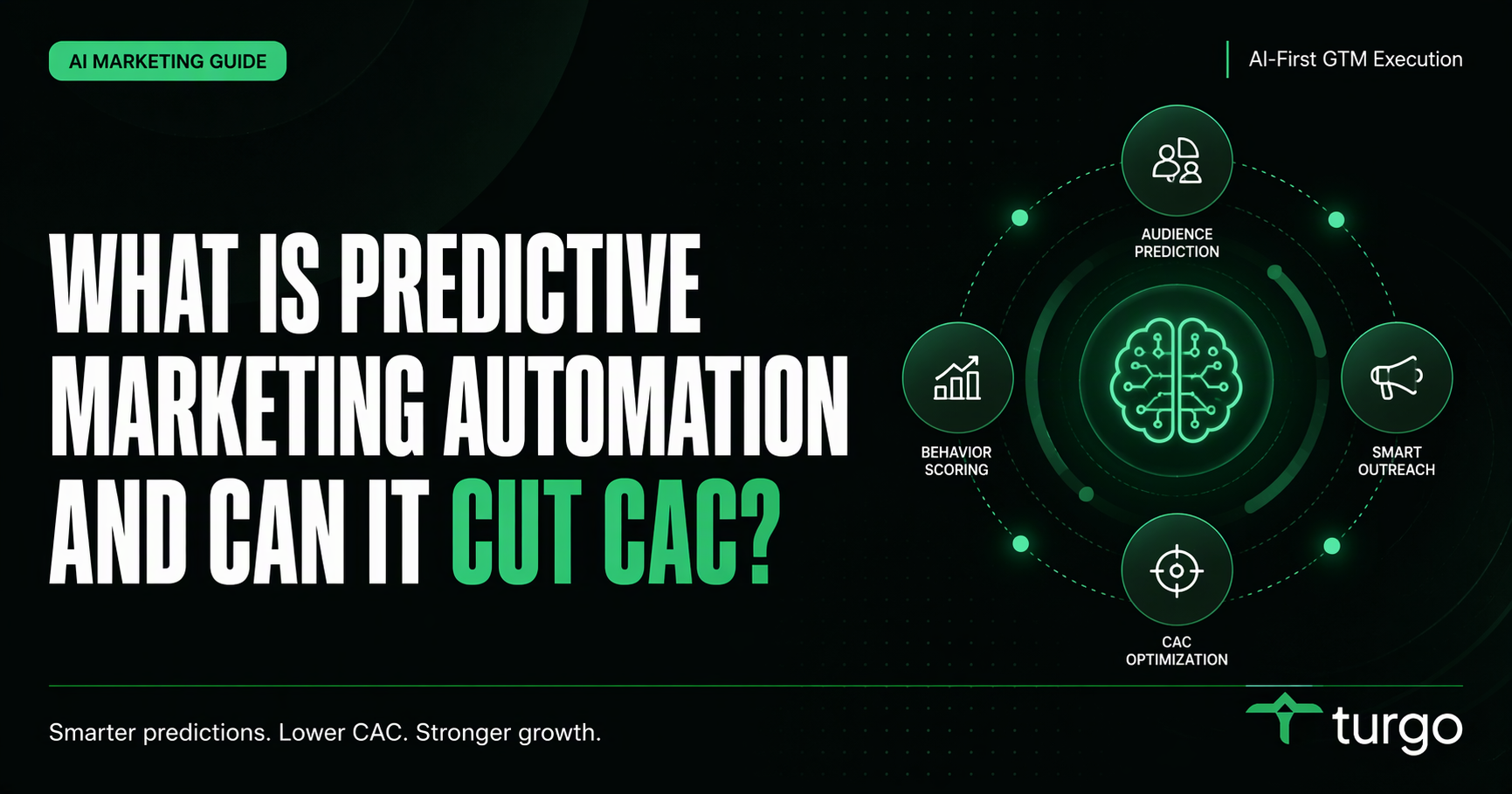
What Is Predictive Marketing Automation and How Does It Work?
Predictive marketing automation uses customer data, statistical models, and AI to anticipate likely outcomes and trigger relevant marketing actions. Learn how predictive scoring, behavioral signals, workflow orchestration, and human oversight work together to improve pipeline efficiency, CAC control, and revenue velocity.
Predictive marketing automation connects two capabilities that are often managed separately. Predictive analytics estimates what a prospect or customer may do next; marketing automation turns that insight into a timely action. Instead of relying only on static rules, teams can prioritize audiences, adjust journeys, and allocate attention according to predicted intent or likelihood to convert.
The value is not automation for its own sake. It is better resource allocation: sending the right message to a higher-fit audience, routing qualified opportunities faster, and reducing manual work that does not materially improve pipeline. The quality of the outcome depends on the quality of the data, the relevance of the model, and the controls around execution.
What Is Predictive Marketing Automation?
Predictive marketing automation combines predictive analytics with automated marketing workflows to forecast customer behavior and act on those predictions. It can estimate purchase intent, conversion likelihood, churn risk, engagement propensity, or expected account value, then use those signals to prioritize audiences and trigger actions across email, advertising, websites, CRM systems, and sales processes.
Key components include:
- Behavioral and firmographic data collection
- Predictive scoring or propensity modeling
- Audience segmentation and prioritization
- Automated, event-driven workflow execution
- Measurement, feedback, and human review
The distinction from conventional automation is adaptability. A rules-based workflow responds to defined events; a predictive workflow uses patterns in data to decide which action deserves attention. Predictive marketing automation therefore supports AI marketing automation, autonomous marketing execution, and broader GTM automation without removing the need for governance.
How Does Predictive Marketing Automation Work?
Predictive marketing automation typically follows a loop: collect data, generate a prediction, select an action, execute the workflow, and measure the result. The system may draw on website behavior, campaign engagement, CRM history, product usage, firmographic information, and sales outcomes.
A model converts those signals into a useful business prediction. For example, it may identify contacts with a higher likelihood of responding, accounts showing buying intent, or customers at risk of disengaging. The prediction then becomes an input to a workflow: change message sequencing, adjust audience membership, notify sales, suppress low-fit spend, or request human review.
The business impact depends on whether the loop connects to operational decisions. A score that sits unused in a dashboard does not improve pipeline efficiency. A score that changes routing, prioritization, or campaign treatment can help teams focus resources where they have a stronger commercial rationale.
What Data Does It Need?
Predictive automation needs data that is relevant, consistent, and connected to an observable business outcome. Useful inputs may include contact attributes, account characteristics, page visits, campaign interactions, form submissions, product events, sales activity, and historical conversion or retention outcomes.
More data does not automatically create better predictions. Duplicated records, inconsistent lifecycle stages, missing outcomes, and disconnected systems can cause a model to identify patterns that do not reflect real buying behavior. Teams should define the decision first, then determine which data supports it.
A practical data review asks whether the organization can explain where each signal originates, how often it updates, and what action it will influence. Clean, decision-ready data helps prevent wasted spend, poor lead routing, and inflated CAC caused by pursuing audiences that appear active but do not progress.
What Predictions Can Marketers Make?
Marketers can use predictive models to estimate outcomes such as conversion propensity, engagement likelihood, churn risk, next-best action, account prioritization, or expected response to a campaign. The precise prediction should match a specific decision rather than become a general-purpose "AI score."
A conversion model may help prioritize leads for follow-up. An engagement model may determine which contacts receive a particular message or channel. A churn model may trigger education or customer-success intervention. An account-level model may support AI outbound automation by identifying organizations that fit the target profile and show relevant intent.
Predictions should be treated as decision support, not certainty. Their value is measured by whether they improve the quality and speed of marketing and revenue decisions. Teams should compare predicted segments against their own baseline using pipeline progression, qualified conversion, CAC, response quality, and revenue velocity.
How Do Predictive Scores Trigger Actions?
A predictive score becomes operational when it is connected to a clear threshold, event, or workflow condition. When a contact enters a high-priority segment, the system might change message treatment, alert a sales representative, enroll the account in a tailored sequence, or pause an unsuitable campaign.
The action should be proportionate to the confidence and business risk involved. Low-risk actions, such as changing content recommendations or prioritizing a queue, can often be automated more freely. Spend-sensitive or customer-facing actions may require approval, draft mode, or a defined rollback path.
This trigger-action design turns analytics into execution. It can reduce the delay between a meaningful buying signal and the next commercial response, while limiting the manual effort required to monitor every account. The relevant measure is not the number of automated actions; it is whether the workflow improves pipeline quality and resource-allocation effectiveness.
Predictive Marketing Automation vs Traditional Automation
Traditional marketing automation follows predefined logic: when an event occurs, perform an assigned action. Predictive marketing automation adds a model that estimates which contacts, accounts, or actions deserve priority before the workflow executes.
Rules remain useful because they are transparent, easy to audit, and reliable for deterministic processes. Predictive systems are useful when the decision depends on multiple signals or when buying behavior is difficult to capture in a single rule. The strongest operating model usually combines both: rules provide guardrails, while predictive signals support prioritization and personalization.
The difference is strategic. Traditional automation can improve process consistency; predictive automation can improve where attention is concentrated. Neither guarantees better results without sound data and measurement. The comparison should therefore focus on decision quality, execution speed, control, and impact on CAC and pipeline progression rather than on whether one category replaces the other.
Which Features Matter in a Predictive Automation Platform?
A capable platform should connect predictive insight with practical execution. The most useful features are not limited to model creation; they include the controls required to deploy, review, and improve workflows safely.
Look for:
- Data ingestion from CRM, website, product, and campaign systems
- Flexible scoring for contacts, accounts, and opportunities
- Event-driven workflow triggers
- Audience synchronization across marketing and sales channels
- Draft, approval, pause, and rollback controls
- Clear explanations of score changes and recommendations
- Attribution and outcome feedback
- Access controls, audit logs, and data governance
These capabilities distinguish a predictive marketing automation platform from an analytics dashboard that only reports historical activity. For growth and revenue teams, the platform should make it possible to move from signal to action without creating an opaque operational layer.
The business test is straightforward: does the system help the team act faster on higher-value opportunities while preserving control? If it only adds another score to inspect, it may increase complexity without improving pipeline efficiency.
How Does AI Improve Predictive Marketing Workflows?
AI can improve predictive workflows by identifying patterns across large volumes of behavioral and contextual data, generating recommendations, and adapting actions as new information arrives. It can support lead scoring, audience selection, content variation, campaign orchestration, and anomaly detection.
However, AI does not remove the need for a defined objective. A model optimized for opens may prioritize activity that does not translate into qualified pipeline. A model trained on incomplete outcomes may repeat historical bias or favor channels that are easy to measure rather than commercially effective.
The best implementation gives AI a clear decision boundary. Specify the outcome, define acceptable actions, expose the relevant reasoning, and establish review points for higher-risk decisions. This allows autonomous marketing execution to increase operating capacity without turning the marketing system into a black box.
Where Does Predictive Automation Fit in the GTM Stack?
Predictive automation sits between data systems and execution channels. The data layer may include a CRM, customer data platform, product analytics, website tracking, advertising systems, and enrichment sources. The execution layer may include email, paid media, sales engagement, conversational experiences, and CRM task management.
Integration determines whether the system can learn from outcomes. A model that receives campaign interactions but cannot see qualified opportunities may optimize for engagement rather than revenue. A model that can connect activity to pipeline outcomes has a stronger basis for prioritization and attribution.
An effective GTM automation platform should make those connections visible. Teams need to know which source produced a signal, which workflow used it, and what happened afterward. That traceability supports better budget allocation, more reliable CAC analysis, and faster decisions across marketing, sales, and RevOps.
What Role Does Human Oversight Play?
Human oversight provides judgment, accountability, and protection against costly automation errors. It is especially important when a workflow changes spend, communicates with strategic accounts, makes sensitive inferences, or acts on incomplete data.
Human review does not require manual approval for every routine action. Teams can define tiers: fully automated actions for low-risk tasks, approval workflows for moderate-risk actions, and manual decisions for high-impact or ambiguous situations. Paused drafts, editable recommendations, and audit logs make that structure practical.
This balance addresses the central tension in predictive automation: scale without losing control. A review process can prevent irrelevant outreach, inappropriate personalization, and budget waste. It also helps teams learn where the model performs well and where business context should override a prediction.
How Should Teams Measure Predictive Automation?
Teams should measure predictive automation against the business decision it changes. If the workflow prioritizes leads, evaluate qualified progression and sales acceptance. If it changes campaign allocation, evaluate pipeline efficiency, CAC, and contribution to revenue. If it manages retention journeys, evaluate renewal or expansion outcomes.
Leading indicators can include prediction coverage, data freshness, routing speed, workflow completion, audience quality, and human override frequency. These reveal whether the system is functioning operationally. Outcome metrics show whether that activity matters commercially.
Avoid treating model accuracy as the only success criterion. A highly accurate prediction may have little value if it does not change action. Conversely, a simpler model can be commercially useful if it improves prioritization and reduces wasted effort. Measure the tactic against the organization's own baseline and account for changes in audience, offer, channel, and sales capacity.
What Are Common Predictive Automation Use Cases?
Common use cases include predictive lead scoring, account prioritization, churn-risk identification, next-best-action recommendations, personalized journey orchestration, and campaign or audience suppression. Each use case should begin with a recurring decision that consumes meaningful team capacity.
For example, predictive lead scoring can route attention toward prospects more likely to progress. Account prioritization can help an outbound team focus on organizations that fit the ideal customer profile and show relevant activity. Churn-risk workflows can coordinate education, support, or customer-success actions before disengagement becomes difficult to reverse.
Turgo customer Tiggo generated 108 qualified opportunities with no added SDR headcount and recorded an 81.53% email open rate across its multichannel sequences. Turgo customer Bubbl produced 80 qualified leads with fully automated, event-driven outbound. These are general autonomous-execution results, not guaranteed outcomes from predictive marketing automation; measure this specific tactic against its own pipeline, CAC, and velocity baseline.
How Should a Company Implement It?
Implementation should start with one repeatable, measurable workflow rather than a broad transformation. Select a decision such as lead prioritization, account routing, or content sequencing, document the current process, and define the action the prediction will change.
Next, audit the available data and establish governance. Identify the source of each signal, clarify ownership, define retention and access rules, and decide which actions require approval. Start in draft or paused mode where spend or customer-facing communication creates material risk.
Finally, monitor both model behavior and business outcomes. Review false positives, false negatives, overrides, data drift, and workflow failures. Expand only when the team can explain the system's decisions and connect its actions to improved pipeline efficiency, more focused resource allocation, or stronger revenue velocity.
What Is the Future of Predictive Marketing Automation?
Predictive marketing automation is moving toward systems that combine forecasting, content generation, workflow decisions, and execution in a more continuous operating loop. The direction is not simply more automation; it is better coordination between signals, decisions, and measurable business outcomes.
As systems become more autonomous, transparency and control become more important. Teams will need clear permissions, explainable recommendations, outcome feedback, and reliable ways to pause or revise automated behavior. Predictive systems that cannot show how they reached a recommendation will be harder to trust in high-consequence workflows.
For marketers, the strategic opportunity is to shift from isolated campaign management toward an always-on revenue system. That means fewer disconnected tasks, faster response to buyer signals, and more deliberate allocation of people and budget. The practical priority remains unchanged: begin with a clear decision, measurable economics, and safeguards that preserve human accountability.
How Can Teams Connect Predictive Automation to Revenue?
Revenue alignment requires translating predictions into actions that marketing, sales, and customer teams recognize as commercially meaningful. A score should influence a queue, campaign, offer, route, or intervention—not remain an isolated field in a database.
Create shared definitions for qualified leads, target accounts, pipeline stages, accepted opportunities, and revenue attribution. Then map each predictive workflow to the stage it is intended to influence. This prevents marketing from optimizing engagement while sales evaluates pipeline quality using different criteria.
The operating benefit is stronger coordination. When teams share the same signals and outcome definitions, they can identify where pipeline stagnates, where CAC is rising, and where response delays are creating leakage. An autonomous marketing execution approach can support that coordination when it connects intelligence to controlled action rather than treating automation as a separate layer.
What Should Buyers Ask Before Choosing a Platform?
Buyers should ask how the platform uses data, how predictions are explained, which actions can be automated, and how outcomes feed back into the system. A demonstration should show a complete workflow from source signal to prediction, action, review, and measurement.
Important questions include:
- Which systems can the platform connect to?
- Can teams edit, pause, approve, and reverse workflows?
- How are predictions explained to operators?
- Which data is stored, and how is access controlled?
- Can the platform distinguish engagement from qualified pipeline?
- How are model drift and workflow failures monitored?
- What reporting connects automation to CAC and revenue efficiency?
The right platform depends on operating maturity, data availability, risk tolerance, and the complexity of the GTM motion. Buyers should evaluate the workflow, not only the feature list. The strongest fit is the system that improves decisions while remaining understandable to the people accountable for pipeline and revenue.
Is manual prioritization becoming a revenue constraint?
When every account receives similar attention, pipeline efficiency can stagnate while CAC rises through undifferentiated spend.
The hidden inefficiency is not a lack of activity; it is allocating resources without a reliable view of likely outcomes.
Measure whether predictive workflows improve prioritization, response speed, and revenue velocity before expanding automation.
See how Turgo executes this autonomously. Start free at turgo.ai.
FAQ
What is predictive marketing automation?
Predictive marketing automation uses data and AI models to forecast likely customer behavior and trigger relevant marketing actions. It can estimate conversion propensity, engagement likelihood, churn risk, or account priority, then use those predictions to influence segmentation, routing, messaging, or campaign treatment.
Unlike basic automation, which follows fixed if-then rules, predictive automation considers multiple signals and can update decisions as new data arrives. It does not guarantee an outcome, and its quality depends on data accuracy, model design, and workflow controls.
The practical goal is better resource allocation: helping teams focus effort on higher-value prospects, respond to meaningful signals sooner, and reduce repetitive manual work that does not improve pipeline.
How does predictive marketing automation work?
Predictive marketing automation works by collecting relevant data, generating a prediction, applying that prediction to a workflow, and measuring what happens next. Data may come from a CRM, website, product, campaign, advertising, or sales system.
A model can assign a propensity or priority score to a contact or account. The workflow then uses that signal to route a lead, adjust messaging, recommend an action, suppress an audience, or request human approval.
The process should be treated as a feedback loop. Outcomes such as qualified progression, opportunity creation, retention, or revenue influence future decisions. Teams should also monitor data quality, false positives, false negatives, and overrides to ensure automation remains commercially useful.
Why do marketers use predictive automation?
Marketers use predictive automation to improve prioritization, reduce repetitive work, and coordinate actions around customer signals. Instead of treating every contact or account the same, teams can focus attention where the available evidence suggests stronger fit, intent, or risk.
It can support lead scoring, account-based marketing, personalized journeys, churn prevention, audience suppression, and next-best-action recommendations. These applications are most valuable when they influence a recurring operational decision.
Predictive automation is not a replacement for strategy or creative judgment. It helps teams execute a defined strategy more consistently and at greater scale. The business case should be measured through relevant outcomes such as pipeline quality, CAC, response speed, conversion progression, and revenue efficiency.
Is predictive marketing automation the same as AI marketing automation?
Predictive marketing automation is a specific application within the broader category of AI marketing automation. Predictive systems focus on forecasting likely outcomes or behaviors, while AI marketing automation can also include content generation, conversational tools, anomaly detection, recommendations, and autonomous workflow decisions.
The categories overlap in practice. An AI system may use predictive scoring to prioritize a lead, then generate a message and schedule a follow-up. Predictive modeling supplies decision intelligence; other AI capabilities may support content, orchestration, or execution.
The distinction matters when evaluating platforms. Buyers should identify whether they need forecasting, automated action, generative assistance, or a combination. The platform should connect those capabilities to measurable business decisions rather than present AI features without an operating use case.
What data is required for predictive marketing automation?
Predictive automation requires data that relates to the decision being made and the outcome being predicted. Common inputs include firmographic attributes, behavioral activity, campaign engagement, website visits, product events, CRM stages, sales activity, and historical outcomes.
The data should be consistent enough to support comparison across contacts, accounts, or time periods. Missing outcomes, duplicate records, inconsistent lifecycle definitions, and disconnected systems can reduce the usefulness of predictions.
Teams should begin with a data audit rather than assume more data is automatically better. Confirm the source, freshness, ownership, and permitted use of each signal. A smaller set of reliable inputs can be more useful than a larger collection of poorly governed activity data.
Can predictive marketing automation replace marketers?
Predictive marketing automation generally supports marketers rather than replacing the strategic and contextual judgment they provide. It can automate repetitive analysis, prioritization, routing, and execution, while marketers remain responsible for positioning, audience understanding, governance, and commercial decisions.
Human involvement is particularly important when workflows affect advertising spend, sensitive customer communications, strategic accounts, or brand reputation. Teams can use approval steps for high-risk actions and full automation for routine, reversible tasks.
The objective is to increase productive capacity, not remove accountability. When marketers understand how predictions are formed and can edit or pause actions, automation becomes an operating advantage rather than an opaque system that creates new risk.
How should predictive automation be measured?
Predictive automation should be measured according to the business decision it changes. Lead-prioritization workflows may be evaluated through qualified progression, sales acceptance, opportunity creation, and pipeline quality. Campaign-allocation workflows may be evaluated through CAC, pipeline efficiency, and revenue contribution.
Operational measures also matter. Review data freshness, prediction coverage, workflow completion, routing speed, override frequency, and failure rates. These indicators reveal whether the system is functioning as intended.
Do not rely on model accuracy alone. A prediction can be statistically strong but commercially irrelevant if no action changes. Compare the workflow with the organization's own baseline, account for changes in audience and sales capacity, and continue measuring after deployment.
What risks should companies consider?
The main risks include poor data quality, opaque recommendations, incorrect targeting, unintended spend, privacy issues, and over-automation. A model can reproduce historical bias or make confident recommendations from incomplete signals if teams do not monitor its behavior.
Risk controls should include clear permissions, data governance, audit logs, approval workflows, pause controls, and documented rollback procedures. Teams should also define which decisions must remain human-led.
Start with a narrow use case where the impact is measurable and the actions are reversible. Review false positives, false negatives, and unexpected outcomes regularly. Predictive automation is most reliable when organizations treat it as a governed operating system for decisions—not an unattended replacement for judgment.
Citations:


